HomeArticles Posted by Ashfaque Zaman (Page 2)

Bangladesh Brand Forum’s flagship held its 5th Leadership Summit. This year, the vision was to groom leaders for the next decade with the tagline “Bangladesh Dialogue for the Next 10 Years”. Powered by Beximco and AIUB, 5th Leadership Summit took place on 7 April, at Le Méridien Dhaka.

This summit included the presence of leaders of various industries who shared their idea in order to prepare the future leaders. Divided into four key segments: Economy, Planning & Strategy, Innovation, and Sustainability, the summit revolved around different leadership aspects from both national and global perspective, presented by the government, private sector and global experts. Anwar Group of Industries supported this momentous initiative as one of the event partners. 
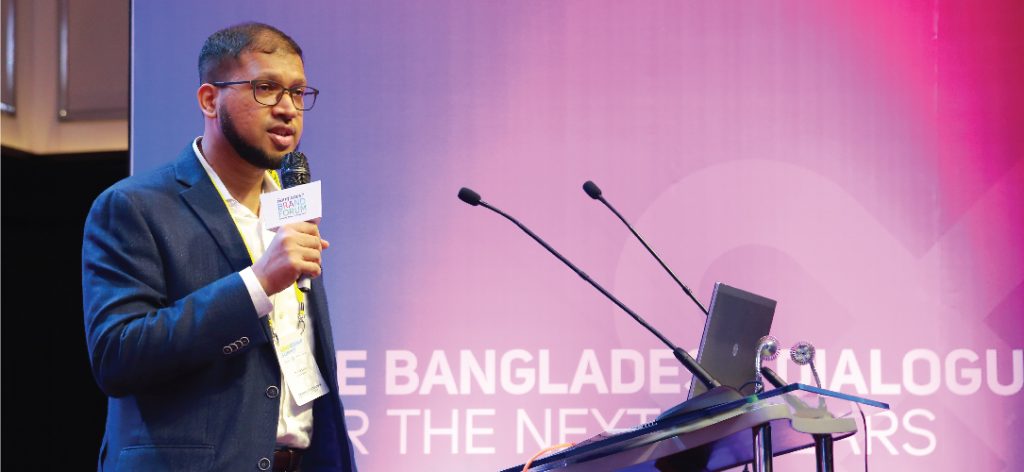
Dr. Mir Salim
Principal
The Boston Consulting Group

Google Analytics has an algorithm that helps them recruit and retain talent. How can any other company apply this system? 
There are two aspects to that; it is about talent recruitment and retention because they conduct this process very well. It is about understanding that recruitment and retention make sense for that company. For example, if you are Grameenphone, you need to understand what drives retention for that particular company. Applying the Google algorithm could help you bring talent to the table. But I think the idea that you really need to unlock is that we have all this data about how people are staying in the firm, moving in different directions, and leaving the firm. How can they harness that data to answer questions like when are predicting a burnout from one of our employees and they are at risk of leaving. It is about coming about the right algorithm for that company. But make it strategic to your company.

Billion dollar companies have moved to Asia such as China and India. What can Bangladesh learn from these nations?
I know the shift is definitely happening in these companies. It is not just about them coming here; many of these companies are homegrown. Many of them are exactly in Asia like India and China. It is just not about what makes a billion dollar company its net worth. It is understanding the journey that is needed when establishing such a company. When we spoke about the disruptions that are happening. There is an opportunity in all of those which can be combined with leadership, strategize and find out which expansions are out there, the right time to expand and all the enablers that are needed in order to tap into that market and win. What is special in these nations is that they have taken what has worked in the West but they have not been shy to introduce their own takes on these disruptions. I can give you one example from India. There is a famous software IT company, Infosys, that has a very small HR department. It is a 50,000 person company with only 100 people working in HR. It seems very small but they are able to empower people to do the right things and provide strategic elements to help guide them. This has not been emulated in the West. It allowed this company to build into what it is today. For Bangladesh, this means they have to capture some of the elements of shift which are needed, recognizing the strengths we already have and which are needed and which we can build. Finally building it to make it work.

Could you detail the shift in the business model, the economic model, and the political model?
On the economic shifts, the single notable change that is coming is the multiple pullers; what this means is that you do not have one superpower from a consumption or an export production standpoint to really dominate the rest of the globe. We have had that in China and the US but that dynamic is shifting now. You have a middle-class affluent population that is well dispersed and not sitting in specific pockets. It is about understanding where those opportunities are and then harnessing those opportunities to find a customized built-in way to incorporate those. The world is shifting away from what China and the US need to do and how it drives us. The business part has this element towards moving to services. It means making a lot of merchandise into trade products into service. When I moved to Malaysia, I tried to buy myself a car duster but I could not find a proper car duster because they have made it into a service. You do not dust your car, you go to a designated place and they do it for you. When you add service elements to products, they become more valuable. This dynamic is seen in aircraft engines. You no longer just purchase the engine. You need the guarantee, the maintenance and repair that comes with it and even the upgrade. There is a move towards what drives businesses. It is not necessarily a global value chain where you need a part of production in Bangladesh, India, and China or the Middle East. It is about understanding what aspect of the global market you need from there and supplementing that with centralization. Uber is a great example. You have a single model that centralizes everything but it is localized in its implementation. The drivers for Uber cars are local, the cars are local assets, and the way you get around is also local. Uber does this a national, geographic and city level. And it allows autonomy but it is still integrated at the end of the day and centralization. The third part is critical. We have always been about multilateralism when there has been a discussion of economic and politics winning and trade taking the front seat and politics taking the second; that hierarchy is now shifting. And what needs to happen in this situation as regular people functioning in the ambit of what is happening around us. We need to recognize this and pick up the right areas that we need to focus on. When I spoke about the multilateral financing of the organization, this is important because it is about the shifting of funding. When you are a company in Bangladesh and need the financing, where are you going to get this? Is it going to be western driven or are you going to get it from a financial entity? It has to do with geographic location and financial ability of these organization and their way to build a more active role is more limited.

What regulatory steps can the government take to foster a better business environment?
One of the examples of this is, I would say, Makerspace. The idea is that you have very small, arguably sub-scale companies that are trying to achieve similar things in individual pockets. There is a wealth of productivity that can happen through collaboration. In old class economics, we call it thick market externalities. There is value in Silicon Valley and it is having that space in which all these companies can collaborate with smaller companies to make a change. The licensing, sometimes this is too expensive for smaller companies to afford them. Once they have the scale they will be able to do that. We can have a method of communal license that can be tapped into that. The third example is best practice sharing. It is about bringing a forum that is more successful that can be learned from and emulated. Small companies to enable this at scale. Samsung can talk to them. It becomes difficult for the largest companies. But we want to inspire and provides knowledge and expertise.
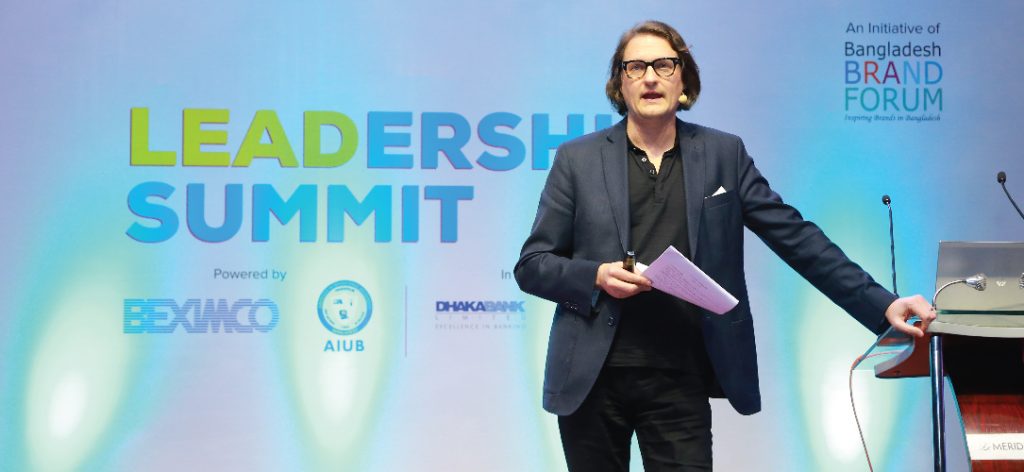
Professor Robert C Wolcott
Clinical Professor of Innovation & Entrepreneurship, Kellogg School of Management
Co-Founder & Executive Director, Kellogg Innovation Network

AI Robotics systems taking on jobs. How do you propose we prepare ourselves? 
Regarding automation, part of the trick, the opportunity, and the threat is that honestly not much is going to change in the next couple of years. There are already lots of really extraordinary advancements going on but in terms of the overall picture and the economic dynamics in Bangladesh, in the next few years, the impact will be minimal. The good news is that it gives us time to think this through. The bad news is the impact of automation will not be present in acute enough fast enough for business and government to take the action now that they should be taking in order to adjust. In 10 years or 20 years, and this is the horizon that Bangladesh is looking at in order to become a fully developed country, the horizon of it the impact will be profound. To give an example, earlier today we heard the chief economist of Bangladesh Bank, Faisal Ahmed, as he was speaking about enhancing productivity, automation is a great way. In the context where you have 160 million people, a large chunk of whom need gainful employment, figuring out how to raise efficiency through the use of automation and also robotics and AI. How do we figure out how to bring these technologies now? Leapfrog is the keyword, where others are also using that to bolster and develop how much people in jobs can accomplish and what they have so that individuals have the capability to utilize that technology and find other roles for themselves to play. And this will be a moving target. The answer to this question in five years will be utterly different from what it will be in 20 years. This is the biggest challenge, it will happen very quickly when it starts to cascade through different industries at varying rates. Look at what digitalization has done to media and how it has ripped apart the models of newspapers, magazines, and television with online and social media. It will affect all industries from natural resources to factories in very different ways.

You have recently written about how Viva Activa is a model that explains the change in automation and robotics. Could you detail this theory?
One of the reasons I was struck by Hannah Arren’s work is that she wrote this in the 1950’s and automation was starting to become a factor. We were not talking about AI or the robotics that we think about today. Automation and machination were going on in the factory. She was thinking penetratingly about the long term. I found it exciting that she was thinking about the very long term and leveraging resources from thousands of years ago, the ancient Greeks. In the human condition, her work struck me as providing a map of where we are going in the next 20 to 50 years. Her pyramid has three hierarchical levels: labor, work, and activity.

- At the base of her pyramid, we have labor, which simply refers to any activity that results in the inputs to metabolism in other words such as food production, finding water, growing grain, raising animals to eat. Anything where we expend energy to create something that we consume and it goes away. Furthermore, we must continue to consume over and over again to support metabolism. It is mostly agriculture but it is bigger than that.

- A level above that is what she calls work. It refers to any activity humans do in order to create the artifacts of human life. In order to create things that hypothetically or notionally might last forever. We don’t necessarily mean forever but this table for instance or the mobile phone used to record this conversation would be the examples of outputs of work. Interestingly this also includes creative arts, physical creative arts like a painting. That in her framework is the output of work, human artifacts of our lives.

- At the top of her pyramid is action. By action she means specifically engagement between human beings; arguing points, building perspective, the political sphere. She does not limit it to politics as we think about it in government and governance. She means in terms of how we relate to each other and relate to the world, how we communicate and how we envision the future and promulgate the future and our beliefs and vision. The argument of what some might call engaging in the community. This is what she means by action. What struck as I was reading it was that she laid out a skeleton of how automation and technology have cascaded across all of the activities of humanity. For example, how long have we been using technology to improve the productivity of agriculture? 150 years ago most Americans were on the farm, today under 2% are of the US workforce is engaged yet agricultural productions are orders of magnitude greater than the previous times.

Therefore, we have already made this happen and those people have transitioned into what you may call activities of work and manufacturing artifacts. Some have transitioned into the sphere of argument, the sphere of argumentation and governance which she refers to as an action. So what we will see after 100 years is the intensification of the application of technologies will not only automate the provisions of the fruits of labor, which in her case means metabolism. Moreover, all of the factors of work will increase take human beings out of the process and put artificial intelligence into it. Eventually, we will be faced with a realm that only provides us with action. I want to add a qualification of hers that I agree with. At that point we will have the option to dig a ditch if we want to, We can make that table if we believe it will motivate us or make our lives better than we are welcome to do that but that is unlikely to be the dominant set of activities that we will do to build a living in societies. The dynamic process, the decisions you make create paths that take you in one direction more than the others.

You emphasize education in innovation and finding purpose. How do you help people find purpose?
I want to underscore that, people don’t have to find purpose or mission. Your life is far better when you do. Very few people ever feel like they find their singular purpose in the world. And it might not be that you have a singular purpose in the world. For each of us, it may be a moving target. There are people who spend their entire lives dedicated to curing cancer or that one pursuit. There are also those people who seek a variety of missions over time and find great comfort and motivation in doing so. The real point of the article is that as technology can increasingly do anything the question for each of us becomes what should we do. The skill is how do I envision and decide what almost none have been trained for. I know in the US and similar in Bangladesh we learn about subjects skills and capabilities. We learn about leadership. But do we learn how to go through a process or how to answer the question for ourselves? What is my purpose? What should I be doing and why? And by purpose, I do mean the long-term I really want to cure cancer and whatever it happens to be or build a great company. I also mean the nearer term questions like what should I do with my career. Very few of us have been given the tools to ask those questions and in the future where so many things we take for granted will be automated or automatable. We have a far greater need to address this question of purpose over and over in our lives. I say if we can help people answer that, we can help people live a more fulfilling life and society is going to be more prosperous.

Once you give people examples of other and their journeys either through stories and cases but also through direct cases and they get to hear each other’s stories. This inspires and helps people gain perspective. Secondly, you introduce them to people outside their current space; whether that is geography, industry, discipline or background. When we see different human being from different backgrounds tackling various challenges, it causes and sparks our micro-neurons to empathize with them and try to discover their mission. Bringing people together to network, see their relationships helps them through stories. Science is showing this more now that human beings are learning far better through stories than through frameworks or equations. There are some exceptions. People remember, they identify with and change mindsets and thinking through meaningful stories.


Bangladesh is a nation of farmers; seven out of ten persons of the 160 million people live in rural areas according to World Bank. Moreover, as the WHO data suggests, nearly 97,400,000 of these people depend on agriculture for sustainable income, generating $112 million in 2017.

Pran RFL is taking the traditional means of sustenance and income into the everchanging modern market. With the largest supply chain in the country, the agro-producing conglomerate has taken agriculture from the roots a fractious nation into the international playing field. The company’s export increased 25% year on year on an average, even since they started going global. The brand equates its success to policy; they believe that instilling a sense of quality from within creates the best product throughout. They have created a culture that values the freshest and tastiest products.

The Units that Link Sustainability
Running such a large supply chain entails long-term quality, good manufacturing practices, state of the art machines, and a proficient sales and distribution network.
Quality of any product starts with purchasing the best raw materials. Pran RFL currently engages with 100,000 contact farmers throughout the nation, a concept they introduced in Bangladesh. The contract farming provides buyback facility to the farmers, besides ensuring fair price and free marketing of their produces; at the same time, the quality of the products are ensured too. Once a farmer is recruited, they are trained and educated about the detrimental use of certain insecticides and fertilizers. The company ensures that their farmers yield the best products by playing the role of the marketer. The farmers focus on particular crops that have the best harvest in their respective region. The company’s buyback guarantee leaves them without worry as to where they will sell their crops.

The Last Mile Is a Tactical Tread
The manufacturing giant has created an integrated operations system that reaches the market with the utmost efficiency. It starts with surveys that help the company understand the necessity of an eclectic market. This allows their dealers to understand the markets of the region and what it demands.
When it comes to food products, timing is everything. Pran RFL contains the largest distribution network in the country. They have created their own infrastructure to ensure that any one of their 17,000 distributors, the largest in the nation, receive the product immediately after it is ready for the market. The company’s buffer stock reaches the depots in a mere four hours after it is ready for sales. They also understand that Bangladesh is a country with unique topography so they do not only rely on any one of their 2,500 vehicles to transport the product. In the riverine regions (Barisal or Balichor), especially in the south where roads are not as of yet developed, the company uses any of its barges that are always ready to transport good from the respective factories.

Create Employment, Usher Changes
Pran RFL’s mission ‘To generate employment and earn dignity and self-respect for its compatriots through profitable enterprises’ is not just words for the company, their ever-growing chain of farmers is proof that they make use of their mission. For them, the farmer’s focus is the land. If there is a sudden price fall of any produce, Pran RFL ensured their farmers that they would have a market with Pran RFL and they need not worry about income.

Moreover, the company seeks to create a culture of change. They train their farmers on the benefits of rearing livestock. A trade that was traditionally thought of as a hobby for women can be a sustainable source of finance for the average family according to Pran RFL. They not only educate families about the benefits of rearing cattle and producing dairy products, the company facilitates loan schemes from banks as introducers that allow farmers to purchase livestock.

From Grassroots to Global Domination
Not only has Pran RFL dominated the national market, they export a significant portion of their 63 products to 134 nations. And this success starts with instilling their importers with the idea of Pran RFL as a brand. The importer then promotes the products according to the company’s guidelines and communication material.

On any given week, the arrival of 18,000 new Rohingya refugees is a small number. It would be considered one of the less turbulent weeks during an influx that has displaced nearly 700,000 people from Myanmar in less than six months. The fleeing population cling to makeshift boats in dark waters and tread uninhabited jungles in search of safety.

Escaping into the unknown is a matter of survival. It is a matter of fight or flight as shootings, arson, massacres, brutality, and rape are a regular reality. They resort to scavenging along the way, holding whatever remnants they can carry of their former lives. Shelley Thakral, Communication Officer, World Food Programme (WFP) recalls a pregnant woman’s tale of survival. She explained that she would pick leaves and keep them in a bag for when she was hungry. The disruption to food access is the start of a cycle of under-nutrition leading in many cases to malnutrition. Because of the importance of development for young children, we have made it a priority to create specialized nutrition centers for children and pregnant and breastfeeding mothers.”

These centers provide sessions that teach mothers the importance of nutrition and safe food preparation. “We do not just supply them with fortified nutritional porridge; they need to understand why it is important to receive additional food beyond their normal diet. Many of these women are stunted themselves from their early childhood, and have micronutrient deficiencies made worse in a time of extreme stress and trauma, lack of food and a difficult journey.”

WFP starts their intervention by measuring their height, mid-upper arm circumference and taking their weight. The three-step process entails weighing, measuring, and recording their basic health statistics. Shelley emphasizes the need for a data system to monitor nutrition status, “Each woman and child is given a card that keeps a record of their nutrition status in order for us to monitor them when they come back for the next session with a health worker.” WFP also provides basic food requirements to all refugees. “Initially, upon arrival, we provide high energy biscuits, cooked foods, and khichuri (a mixture of lentil and rice) which is commonly eaten in this region. We want them to regain some of the strength. After registration, they are then given ration cards with which they can obtain essentials such as rice, lentils, oil and sometimes supplements such as salt and sugar.”

The matter is much greater amongst this densely occupied region. The makeshift tents and topography make it prone to natural and man-made disasters. The high rate of deforestation to make way for tents and provide fuel for cooking have made firewood scarce. This dynamic introduces a set of protection issues. When women and children go to gather wood they are vulnerable to several forms of gender-based violence.” Shelley and her team also understand that if a fire in the makeshift camp becomes uncontrollable, it can result in a widespread catastrophe. WFP is working to facilitate alternative sources of fuel in order for cooking so as to mitigate all the negative issues associated with deforestation”.

Working towards greater dignity for affected people and affording them the choice of food items including a range of fresh foods, WFP implements a data enrollment service that provides refugees with a food assistance card. It has a $10 value per family member and is topped up monthly. Shelley expounds that technology is an innovator even in the most dismal and dense conditions, “We begin by collecting the biometrics of the senior women in the household and her family members and issue a card under the registered individual’s names. Our priority in this context is women, they are traditionally the overseers of food security for the household. Furthermore, E-vouchers empower the women with choice, promote a ‘regular life’ experience of shopping rather than being purely a recipient, provide a broader diet diversification and help support the local economy.’’Given that the process is very technical and intricate, WFP holds rigorous training sessions that demonstrate how the cards can be used.”

The e-cards can act as a multi-wallet card service and provide refugees with more than a staple food. Shelley details that the system has supported their collaboration with UNICEF and UNHCR, “Collaboration with some of the other organizations at the site have really supported holistic aid. We understand that food is the primal need in this situation. They can purchase staple food and condiments such as garlic, onions, or citruses to impart flavor.” In such adversity, food items are not the only necessity when most arrive with only the clothes they are wearing. “There is a need for non-food items so families will in the future be able to use the card to purchase other items such as shelter provisions, hygiene kits, and blankets. When there is very little access to money, the multi wallet card is an inventive financial solution.”

Data collection and research activities act as a catalyst to the aid direct intervention. Shelley illustrates that a cross-agency referral basis allows for consistent and targeted interventions, “Our food distribution is twice a month. We carry out an assessment to determine the size and portion necessary for each family.” WFP also extends support to the families that require extra attention. “If the household head is a child, an older person, pregnant or with an injury, disability or chronic illness, we have porters who help them carry food from the distribution point. A single mother may also require support services and we address this accordingly. We try to promote dignity in our distribution points by making sure toilets, clean drinking water and a private place for breastfeeding are available.”

A lesser seen challenge when such a large community had been displaced is the conditions of the host community. Teknaf is not an economically sound community; the local host community consists of 12.5% highly vulnerable and 25.5% moderately vulnerable people. WFP has worked with the local people for years providing them with support programs.
“We have established school feeding programs, nutrition support and livelihoods and empowerment programs for sustained community development” Shelley explains. “We also support the local community when it is impacted by natural disasters. Humanitarian assistance is given according to need, regardless of who the person is or where they come from”.

The livelihoods program works with women in the community, empowering them to be financially independent. Shelley affirms that WFP has integrated a package of grant schemes for income-generating activities as well as series of Behavior Change Communication sessions that help in the socio-economic empowerment of the local women, these women are organized into self-help groups, nurtured to be independent and some even get registered officially within the District of Women’s affairs records. “I recently met a woman who had opened her own shop. You’re not just giving them a means of finance – this is a tool for empowerment and security which has also allowed them to transform their lives, especially in their food security and ensure their children can go to school, Shelley emphasizes the attention and regular visits to the host community in order to equally address their need: “When a community is not economically sound itself, you cannot simply aside their needs in such a crisis. It is imperative to find a balance between both populations. We are currently running the third phase of our support programs that focus on food, nutrition, and livelihoods for both the communities. In the local host communities, 100,000 people will benefit from this support.”

There are countless stories of trauma, starvation, and massacre as Rohingya continue to arrive. Nevertheless, the focus must be on securing a future that recognizes their basic human rights.

Leaving the kettle to brew has become an instinctive nature for morning commuters. Whether it’s a green tea that needs to sit in the water that’s just the right temperature or two spoons traditional black tea boiled generously with sugar and milk, nothing is quite welcoming as that morning cup. And it comes as no surprise that every roasted leaf adds up to a $40.5 billion global industry.

Maintaining market standards as rich as the history of this staple, Ispahani is the largest contender in Bangladeshi market. Producing, blending and packaging top quality tea for years has made them a conglomerate with 520 sales centers and 25 divisional sales offices. Their fundamental approach is offering, communicating and delivering value.

It starts with expert tea tasters and blending experts go through a thorough procedure to ensure that only the best, freshest and finest tea leaves go into every pack. Every year a quality assessment team of ISO visits the tea blending and packaging plants and accordingly, regular upgrading of systems and machinery to meet world-class quality parameters. They continually conduct research, product blind tests, innovations, and renovations along with some brand building campaigns every year to stay ahead of the competition.

Their most recent campaign, ‘Tea means Ispahani Mirzapore’ declares that “the richer blend and great taste of Ispahani Mirzapore Tea let you live every moment filled with love.” They want to promote tea as an experience with loved ones. Constant innovation to meet the consumers’ demand is how they have built a brand loyalty reminiscent the everyday pick me up. 

STRATEGY FROM THE ROOTS
While marketing their tea, Ispahani believes that retailers and consumers are equally important. Retailers are the initial point of promotion because they have direct access to consumers and the power to promote a particular product. Furthermore, retailers communicate product offers, new products or any product information to end consumers. Ispahani makes products available at outlets; communicate offers/benefits to retailers first through sales representatives and then run mass/customized advertising campaign when/where necessary.

Consumers are the ultimate purpose to build a product or brand over the years. The tea giant invests heavily in understanding the changing needs and wants of the tea market. They understand that 99% of the market is a variety of black tea but that does not limit the variety that is increasingly becoming prevalent. Understanding the values of both retailer and consumer is how the brand strategizes. 

BREATHING LIFE INTO EVERY CUP
In 2014, Ispahani relaunched its new pack and repositioned itself with a phrase/slogan - Cha maane life ta bhorpur, cha manei Ispahani Mirzapore (Tea means a full life; tea means Ispahani Mirzapore). They played their first digital campaign in November of that year via Facebook, YouTube, GDN, local news portals, and websites. Nevertheless, they were limited as Google could not display their text in Bengali, their initial target. The national voice of the campaign resonated in thousands of homes. Ispahani Mirzapore received thousands of queries via email and a plethora of comments and messages on Facebook, all of which commended the campaign. This dynamic motivated the company to step towards real-time engagement. With digital media utilization, they found greater depth into the emotions consumers associated with Ispahani. Creating a chain of active conversation and responses with consumers allowed them to focus on real engagement through specific messaged, address the inquiries, and develop a more constant connection with consumers. The company believes that consistency is key in an era when the audience is exposed to such a vast degree of content.

With a campaign budget of Tk. 485,000, it was expected that the campaign would reach 750,000 people, receive 40,000 page likes, 4 million Google Display Network and (GDN) Impression. Just like their tea, Ispahani managed to handpick the best campaign, as it reached 1.8 million people, received 84,400 page likes, and 4.49 million GDN impressions. Moreover, #IspahaniTEA reached 3.7 million people and the picture tagging campaign engaged 307,900.

Overall, the company obtained more than 84,000 new fans and reached 5.5 million Facebook users in a matter of six weeks.

DIGITAL TECHNOLOGY: THE ENERGY BOOST FOR EVERY COMPANY
The company uses this as an opportunity; with data-management capability, they can reach, offer and tailor products and messages accurately and repetitively through specific targeting. The new trend also poses a very significant business challenge from the perspective of competition in the market.

Just like their tea, Ispahani managed to handpick the best campaign, as it reached 1.8 million people, received 84,400 page likes, and 4.49 million GDN impressions.

ANYTHING BUT A DISRUPTION
Ispahani concludes that the digital disruption is economy-wide and will continue to intensify in the coming years. They recognize this and began formulating and implementing a digital transformation strategy to have a competitive advantage. Digital technology has impacted the company in three key pillars:
· Improving customer experience
· Improving operational efficiency
· Increasing the level of agility of the organization 

MATTERS OF MONEY AND MASTER PLANS
Digital technology, sales automation, marketing automation and financial modeling adds value to financial plans of Ispahani. It facilitates better planning and forecasting for the company. Our month on month sales data and reports (from sales automation and ERP software) are used planning for example. The more technology gets into play, the more the company is using them for decision making leads to strategic advantage. Otherwise, only machinery or technology that is bought will not give any result as the convergence of technology is ubiquitous.

TRACKING THE EVERYDAY
Ispahani has implemented technology into its every day. The company witnessed a more efficient operational function in aspects that included:
· Day to day meeting
· Tracking sales force
· Updating sales figure
· Tracking division-wise data.

CREATING FUNCTIONALITY FROM FACT AND FIGURES
Ispahani values using data in order to increase market efficiency. A majority of their data comes from Nielsen Retail Audit, Household Panels are obtained through Kantar MRB, and brand tracking data comes from Kantar Millward Brown. They use a multifaceted tool known as the brand awareness mapping in order to determine their current percentage of awareness, make plans to increase it and finally compare the campaign results against our objectives set. The tool entails top-of-mind-awareness (TOMA), spontaneous awareness, aided awareness, and total awareness. First Choice Brand Consideration (FCBC) metric allows them to determine how many consumers perceive the brand when they feel the need for this particular product in any particular category. We also always look into brand familiarity funnel also known as the brand conversion funnel to measure how awareness triggers to trials; and regular user-ship converted to to most often user-ship. The final weapon in Ispahani’s arsenal is Facebook. The insights from each, frequency, shares, likes, mentions, conversions, and engagement status direct plans for future campaigns.

IT ALL DEPENDS ON WHAT YOU’RE SELLING
Given that Ispahani sells tea which is a production company of consumer packaged goods (CPG), digital campaigns do not suffice in marketing. CPG companies such as theirs must focus on mass markets and mass communication, mass distribution and for this they consider:
· Traditional Media (TV, Press, and Radio)
· Outdoor branding
· Point of purchase
· Digital campaign
CPGs pursue classic value chain model as opposed to the demand of platform that brings together producers and consumers, connect participants and generate value in two-sided markets – app developers on one side and app users on the other. Social media and digital platforms act as facilitators of engagement; they have empowered people and have offered platforms where the owners and consumers can interact with trust and even they can swap roles in ways that generate value for the platform.

Bangladeshis from northern parts of Jessore to the Southern tips of Khulna are most likely to have one thing in common, they’re crippled without their mobile phones. Our love for all things mobile is just as populous as the nation itself. It is evident given that 117 million people own a cell phone. Covering such a vast topography mandates a formidable network. In that sector, Grameenphone (GP) can boast of doing a stellar job. The telecommunication giant has captured the portable screen of almost every other citizen with 65,329,000 mobile subscribers. Being the only network to cover 99% of the nation, the company raked in $1.7 billion. The company doesn’t just talk the talk, walk into their offices and you’ll find over 2,810 employees who precisely know what’s happening in a time where everyone wants the world at the tip of their stealthily typing fingers.

Loading your Arsenal with the Right Ammo
For GP, employer branding is more organically achieved than promotional campaigns. At every level of recruitment, they practice the highest standards of evaluations, which ensures some of the best talents in the market are working with GP. Employees of GP are authentic brand ambassadors to promote the company’s culture.
They believe that employees are a foundation for collaborative success and it starts with picking for passion. The company targets diverse career opportunities to specific groups in order to find an individual who will thrive in their particular area of expertise.

Pedagogy in Practice
GP offers programs that are tailored to attracting students because they understand that the right minds come from an appreciation for academia. The Telenor Youth Forum is a global year-long program that brings together the future leaders amongst the youth to collaboratively tackle social issues around the world. They had more than 1,500 applications last year. GP runs a nationwide competition to collect entries, followed by grooming and developing sessions after which they carefully choose the best. The Grameenphone Apprentice is a part-time corporate training program that focuses on merging on-the-job training and coaching from leaders of the company to ensure that the country’s talent pool is equipped with the skills that modern workplaces require.

Set on the Site
Embedded in the main site of GP, the career’s site (grameenphone.com/about/careers) showcases the company’s major flagship talent program and opportunities. Potential employees can find all the vacant positions within GP listed here with application details. Additionally, it provides career advice directly from employers. The career site works as an information hub for all vacancy related information; this is also where candidates apply for jobs as their application process has followed the global trend of being conducted online.

The Harvesting Process: Only Pick the Best Crop
The application processes in GP is extremely rigorous for all levels of recruitment; initially screened candidates go through online assessments and on spot tests before moving towards the first interviews. The recruiters are trained against bias and perception and base candidate scores on demonstration of their real-life examples; this allows them to identify whether the candidate will be a sufficient fit for the role. The focus is on channeling the right resources to jobs that they would love.
Grameenphone also offers online interviewing to demonstrate the need for flexibility and privacy of candidates while allowing itself to shortlist a greater number of talented resources. GP regularly attends career fairs in universities which allow potential candidates to get a thorough understanding of the application process and they get answers to their queries from recruiters and their alumni in GP themselves.

The Best Content Comes from Experience
GP takes great pride in the success of its family and likewise for the employees of GP for their company. Their employees frequently appear in media with their knowledge sharing/opinion segments and win awards and accolades recognizing their professionalism. Employees also apply these learning to mentoring, developing and career exposure. GP itself is based heavily on organic employer branding, especially for mid-level and higher level recruits. This target group is not likely to be affected by recruitment campaigns or gimmicks. They look for authentic sources of information about candidates from their circles.

GP has hosted knowledge sharing sessions and career roadshows across universities in Bangladesh. The content is entirely prepared by employees from every level. These individuals take sessions in their area of functional knowledge, leadership, and career development.

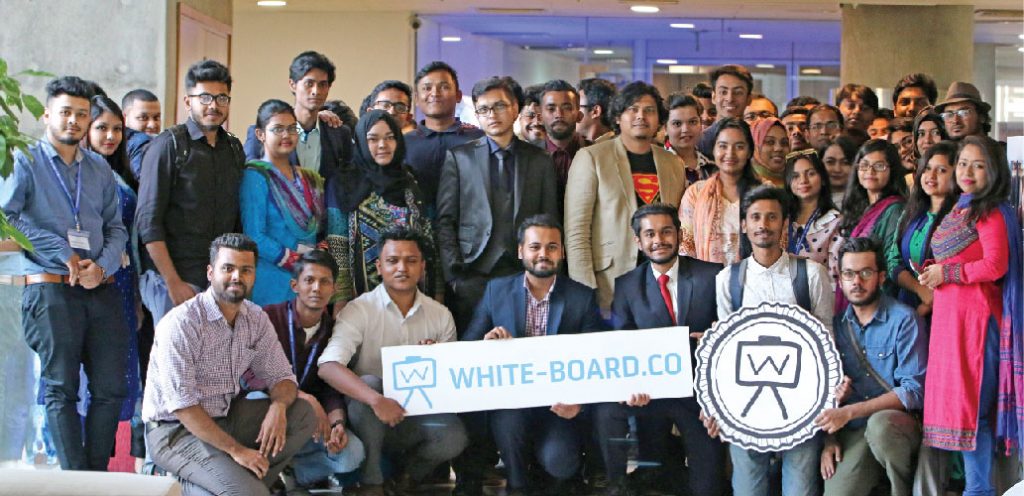
Whiteboard hosts regular sessions for both internal and external audience with a purpose of developing the digital ecosystem in Bangladesh within GP. They held 30 sessions last year with over 2,500 participants. These sessions are conducted by both internal and external resource pool. There are also frequent sessions arranged in GPHouse for university students. Students can directly interact with GP employees and learn about how the business runs and what it takes to succeed in a career.
A recent example of employee-driven content was IloveGP – an inter-divisional campaign that set to depict employee loyalty. Particular divisions would compete with one another by filming a micro video on why they love GP. Employees from seven divisions participated and GP accumulated 11,942 reactions. The internal campaign received some of the most creative demonstrations of highlighting the benefits, culture, and career development. They also recognized the winner via popular and jury choices.

Talent Knows no Gender
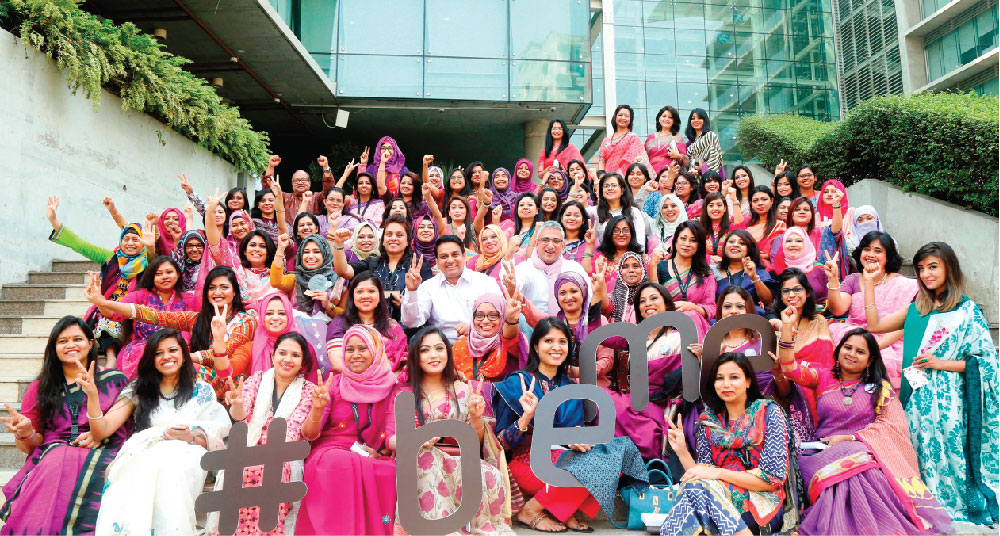
The fact that GP is working to shatter the glass ceiling is evident as they were the recipient of the Most Female Friendly Organization Award in 2016. That same year Telenor Group introduced Launch of Women Inspirational Network (WIN). GP executed a program to provide focused leadership development to women leaders at CXO-1 & CXO-2 levels. The following year, individual and customized development plans were prepared for 45 potential female talents with personality profiles mapping. The WIN members are now mentored by the company’s top management official.
GP promotes gender equality through one the most effective tools to convey a worthy message, the theater. ‘Shuhashinir Cholon Baka’- A first-of-its-kind-play pieced from six real-life stories that depicted both unintentional and intentional bias and discrimination in GP. It was staged in GP office throughout the region with the aim to insight behavioral changes through gender sensitization of all their employees. Furthermore, learning weeks, tailored session, online learning platforms and sponsored training participation and seminars are held to encourage the promotion of female employees to high positions. Interactive sessions are held by women in various sectors. These sessions were conducted by noteworthy women such as Rumana Rahman (BAT), Zara Mahbub (BRAC BANK), Mahmuda Afroz (ADCP), Samia Zaman (DU Faculty and Journalist), Fahmida Jahangir (Rangs) and Mahmuda Afroze (Honorable Secretary in charge, Labour & Employment Ministry).

Platforms that Set the Stage for Unity and Motivation
Through their internal employee engagement surveys, GP has found that employer branding to prime reasons that attract employees. They maintain communication throughout all of their offices via Workplace, a social media platform that is exclusive caters employees of Telenor. Employees can share their success, business updates and share advice with one another.
The company is consistently the recipient of the Divisional Quarterly Award, which recognizes the noteworthy demonstration of performance and values across the organization. The event showcases stories of employee contributions and is championed by top leaders of the company including CEOs and CXOs.

The Ripple Effect: Values that put the Employee First
Employees proactively take initiatives to reach out to communities outside their circles, sharing career advice and corporate grooming. They act as jury members in business competitions and speakers in panel discussions through such events. These actions allow them to highlight their own personal career achievements in the contribution to GP’s success.
GP’s brand promise is to empower societies with what matters the most. The GP Accelerator Program promotes startups that strive for change and Whiteboard creates career opportunities in corporate, technology and commercial units for the digital enthusiast. Their recognition of employees starts at every company’s exposure portal, their website. GP features testimonials of their employees and their content within the company. Campaigns such as the Next business Leader and Telenor Youth Forum focus on the experiences of candidates.

* Photos provided by Grameenphone

The road to travel domination started in 2015. Fast forward three years, Pathao has altered the mindset of how Dhaka city commutes. What initially began with 100 drivers, now has a fleet of over 500 with 300,000 users. The motorcycle is no longer the unsafe sight of eye rolls; it is the convenient way, dependable and economical way to get from point a to b. Meet the CEO of Pathao, Hussain M Elius, as he elaborated upon their start of Pathao’s trip and how they have merged the highways of tech and travel.

A Concept is Never Set in Stone
Two years ago when we started brainstorming about the biggest challenges we faced in Dhaka - we realized that there are two major problems - load shedding, and traffic. We could do nothing about the former, so we looked into the everyday commute. Before we even started Pathao, we tried solving the transportation problems with different tactics- one was a CNG hailing app knows as Jaben. We did not have the same leverage because smartphones were not so densely used; so we went to a phone call based solution. It was followed by a carpooling service which also did not do very well. Long story short, the Pathao app that everyone uses today was not the thing we started our journey with. It is something that was born after many experiments.

Embrace Every Attempt
It took some failures for us to realize what would work and what would not work. A pipeline of ideas helped us come to the current service. We continually iterated on the idea of starting something, monitoring its progress and moving on to the next endeavor if our product did not work. We embrace our failures as an opportunity to learn and develop. Whenever an attempt became a failure, we would dissect it into lessons learned, and contemplate on how we can use the learnings and the technology to develop something better.

The Only Success is That There is None
We used our ability to iterate fast to our advantage. We maintain a culture that asks us to consistently push the team and the organization to do more. We have a new number to hit every week, and the new goal to hit every quarter, and we allocate resources to every effort to strive for that measure. The day you believe that you are successful is the day that you will think that there is nothing more to do. That mindset is harmful because the competition never rests - and it gives others the space to catch up. Every day is a new day.

When the Solution is not There, Create it
Our most significant success was not creating a new technology - but rather a new category of transportation. Creating a category of “motorcycle sharing” was particularly tricky as Dhaka was not a motorcycle friendly city in comparison to others in the region. The culture of sharing rides or taking a motorcycle was not perceived to be safe. Before Pathao, the city had a preconceived notion that motorbikes were unsafe. Furthermore, people in Bangladesh are not very open to the idea of apps in general. Things have changed since then.

A potential colleague is not defined by their background; it is their portfolio that speaks volumes. If they have the Pathao mentality, accompanied with passion and drive, we consider them to be an asset to the company. 


Being a Visionary Paves the Way
At first, people were not used to using any app beyond a few social networks like Facebook. Once Pathao gained momentum, we observed a few changes coming around us. First, many people were buying smartphones because they wanted to use the Pathao app. When you address a massive problem and find a viable solution, the market will find the way to reach out to that solution. We started with getting our first orders through phone calls and Whatsapp followed by a secret Facebook group- but all of those were not sustainable or scalable. All of these mediums entailed a middleman for operations and would take 10-15 minutes before we could confirm a service. An app allowed for an immediate response. We started informing people on the Facebook group that they would have to use the app and stopped taking orders from anywhere outside of the app. At first, it created a lot of friction for customers who were used to giving orders - and changing their mindset wasn’t easy. However, we considered that in the long run how much the customers would gain through the app. We are now running both on Apple and Android phones, and the implementation of the app created much greater access and ease to customers and drivers alike.

Expand Your Service, Stay True to Your Vision
When we started Pathao, we knew that our app would be built for the masses. This led to the concept and execution of Pathao Food. We are in the process of incorporating more restaurants and will have over 3,000 restaurants in by the end of March. We have more than six to ten times the number of restaurants than our competitors. We have targeted the segment of the of the market that the current players have ignored. In the socioeconomic context of Bangladesh, ordering lunch for Tk. 300 to 400 is not feasible on a daily basis. We have smaller restaurants like Star Kebab or CP because ordering a biryani for Tk. 100 is a much more reasonable solution for a meal. We have decided from the beginning of the company that would not serve a niche but one that is accessible to everyone.

Quality is Not Up for Negotiation
We have the general approach to a business where continuous feedback is used to weed out bad drivers or customers. You will have bad customers who will decrease the platform experience for the drivers as well. In this regards, our rating service provides a data-driven solution. When a first-time driver or customer is using the app, we do not have any data points. Once they start exhibiting consistent behavior - we could develop a pattern, and can choose to fix it or remove the problem. Hypothetically, if one customer infers that a driver is reckless, that may not be an accurate estimation of the drivers’ skill because that’s just one data point out of, say, 100. However, if we see that these experiences are consistent and 20 to 30 customers are drawing the same conclusion, then there are more data points to say that yes, the driver is in fact very reckless. This feedback allows us to grow while the quality can be controlled.

Mindset: The Foundation for Growth
People from various educational backgrounds bring their unique skill set. For example, Shifat Adnan, our Co-founder, and CTO, comes from an engineering background, and his contributions and insight in that aspect are very immediate and more specialized. When you grow to a large organization such as ours, the challenges propagate downwards. Individuals from different backgrounds bring insight; one person may be able to draw from their understanding of organizational behavior, while another adds knowledge regarding accounting or object-oriented programming. Starting a company requires many generalists who can do everything. But growth requires specialization.

Nevertheless, we hold a person’s ability to execute and their problem-solving mentality with the utmost priority. We recruit everyone - whether they may be dropouts, current students, and those with degrees, not according to academia but their inherent abilities. A potential colleague is not defined by their background; it is their portfolio that speaks volumes. If they have the Pathao mentality, accompanied with passion and drive, we consider them to be an asset to the company.

In 1952, a young Samson H. Chowdhury started looking after his father’s pharmacy in Pabna. He’d start Square Pharma with Dr. Kazi Harunur Rashid, Dr. PK Shaha, and Radha Binod Roy six years later; this would be the start of many first in Bangladesh. Today, Square Pharmaceuticals Ltd. is the most prominent name in the industry. They have been the largest pharma market holders since 1985, a testament to their unsurpassed quality in the nation. The conglomerate, however, does not limit itself to sheer size; they have been the trailblazers in the industry. Square pioneered the export market in Bangladesh, they constructed the first US FDA and UK MHRA approvable factory, obtained the ISO 9001:2000 certification, partnered with UNICEF as a global supplier and started insulin manufacturing maintaining stringent compliance standard. 2018 would be another benchmark year for the company as they became the first of any pharmaceutical company of Bangladesh to extend their reach on an international platform. Square Pharmaceuticals Kenya EPZ Ltd started construction early last month, marking the company’s reach in the East African Region (EAC). During this endeavor, Square became the first and only company in the nation to acquire transfer equity approval from Bangladesh Bank.

Square Pharmaceuticals is investing $80 million in Square Pharmaceuticals Kenya EPZ Ltd, and for their first phase, they are spending $20 million in creating a facility that can produce 2 billion tablets and capsules annually. 

Checkmate: Understand the Board Before your Move
When considering the investment protocols, Square realized that Kenya would be the ideal investment region because it was untapped by larger manufacturers such as top Indian factories and MNC pharmaceutical countries. These companies are concerned with markets such as Europe, Japan, China and the US (the pharmaceutical market in the US is $240 billion alone). The growth in the EAC region is much less. Therefore, penetration of the market would be much easier and profitable. The entirety of Africa is $40 billion, and amongst that, the EAC region is above $2 billion markets; this has led Square to proceed in the area.
The market size of Bangladesh is nearly the same as Kenya ($2.4 billion). The British ruled Kenya from 1895, and the nation became independent in 1964. This dynamic has made Kenya’s infrastructure, political climate and legal structure very similar to those of Bangladesh. Furthermore, Kenya has grown at the same rate as Bangladesh; the Kenyan market is $745 million with a CAGR growth of 12% for the last five years; whereas Bangladesh’s CAGR is 17%. Both nations are developing at a relatively similar rate.

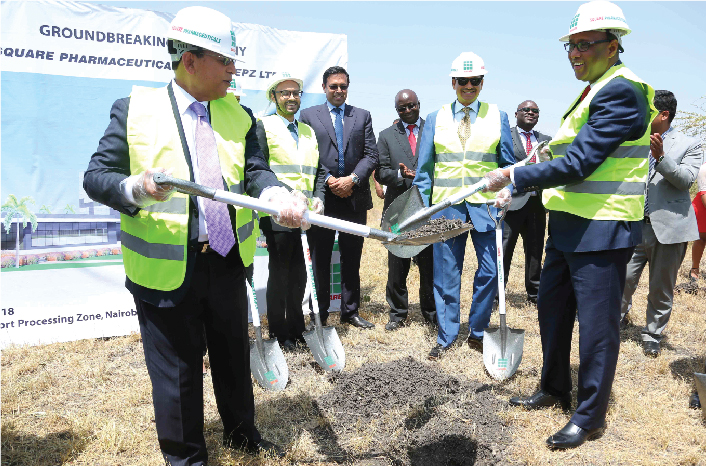
From left High Commissioner of Bangladesh to Kenya H. E. Maj. Gen. Abul Kalam Mohammad Humayun Kabir, Tapan Chowdhury and Adan Mohammad inaugurating the groundbreaking ceremony.

The Investment Initiative: Turn where Favorable
Square Pharmaceuticals considered a few options when they were expanding; these countries included Kenya, Ethiopia, Tanzania, and Uganda. Kenya was the most investment-friendly environment amongst these nations, and the repatriation dividends are the easiest. In the EAC and COMESA countries, Kenya has the most robust manufacturing base. Pharmaceutical products do not follow the MRP guidelines that are implemented in Bangladesh. Hence there is no fixed price for the product.
Also, the different donor agencies and World Bank want to start the idea of making products in Africa for Africa. They are pushing the Vigorous Competition Policy in Africa to create a more self-sufficient continent, after a study they conducted found that 70% of African nations are amongst the globe’s lowest regarding local competition and on the existence of fundamentals for market-based competition. Local products are subject to preference; any product by local tenders will receive a 15% discount. Hypothetically, the preference cost allows a $100 product to come down to $85. On the hand this incentive is not given to imported products, leading that cost to be just the same. Additionally World Bank, donor agencies and the Government of Kenya have created a Pharmaceutical Development Plan which strives to create an environment of efficiency and self-sustainability.
This incentive has led square to construct their factory in the Athi River EPZ. The company will be able to market products at a reasonable price because they have to establish themselves in an EPZ that is specialized in exporting. Square will receive tax, revenue, power, treatment plant and water incentives which in turn subsides the cost of manufacturing. These benefits are considered for any of the EAC member countries and beyond. Local manufacturers can expand their export on the same scale to South Africa, the old CFA countries and Europe which leads to the possibility for a much more significant market.

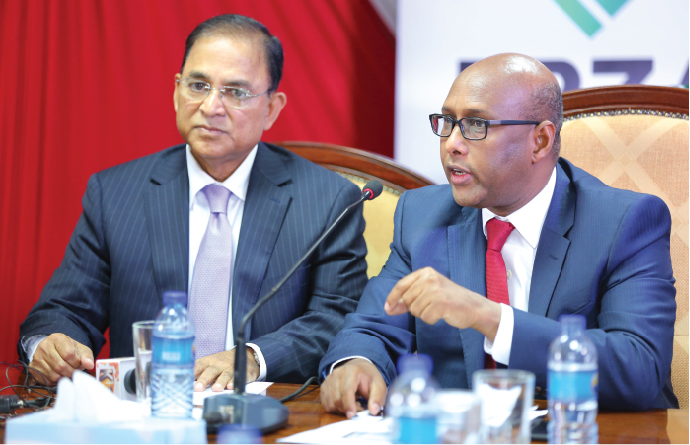
Tapan Chowdhury, Managing Director of Square Pharmaceuticals Ltd. and Adan Mohammed, Cabinet Secretary for Ministry of Industry, Trade and the Cooperatives Republic of Kenya were addressing dignitaries and press on Square’s investment in Kenya.

Gradual Steps Towards a Longer Stride
Square Pharmaceuticals is investing $80 million in Square Pharmaceuticals Kenya EPZ Ltd, and for their first phase, they are spending $20 million in creating a facility that can produce 2 billion tablets and capsules annually. Square Pharmaceutical will start with solid dosage forms such as tablets and capsules. They believe that penetration through a high entry barrier products such as difficult to make and sustained release solid products will ensure that the region recognizes Square Pharmaceuticals as a manufacturer of quality products.
They will continue to liquid and sterile medications such as injection and infusions. Sterile products manufacturing units are rare in Africa. The challenge with sterile products is that the facilities, manufacturing process, and products are expensive. Additionally, there are meticulous regulations while producing sterile products. Square Pharmaceuticals has this edge given that they have been in the sterile production line for the past 33 years. They have been the top manufacturers of sterile products in the nation for the last 25 years. The company has also applied for US FDA approval for their sterile line which they are confident to obtain, succeeding the USFDA inspection later in the year. Their years of expertise allow them to commence with sterile products during their second phase. The third phase of their production will involve liquid dosages. These are the most commonly produced medicines amongst the 23 local manufacturers in Kenya.
The Detail in Demographic
When expanding a market, it involves reflecting on one’s critical demographic. Square Pharmaceuticals is specializing in non-communicable disease medicines given the changing disease trends in Bangladesh. The country has made strides in treating communicable diseases such as tuberculosis and malaria. There is a prevalence of the waterborne disease such as cholera and diarrhea which are also preventable. Bangladesh is now moving towards a higher rate of non-communicable (NCD) disease as life expectancy increases to 70 years of age. With the higher age expectancy, the risk of diabetes, cardiovascular diseases, hypertension, and Alzheimer’s is prevalent. According to the World Bank, NCD accounted for 66.9% of death in 2015 compared to 43.4% in 2005.
Kenya is witnessing the same trend, where NCD has increased from 20.9% to 33.4% of deaths (51% of whom are under 70) during the same period. NCDs account for 50% of inpatient admissions and 40% of hospital deaths in the country. Obesity alone is apparent in 18% of children and 9% of adults. The dietary risks, inactivity, and changes in lipid profile in the region lead to a higher rate of cardiovascular diseases, and hypertension. Moreover, as life expectancy in the nation has increased to 62 years of age, the occurrence of dementia and other CNS diseases will rise. This NCD trend is estimated to double when Square Pharmaceuticals starts manufacturing in 2020, and the company plans to launch with a high-quality yield of these drugs to build trust in the market.

2018 would be another benchmark year for the company as they became the first of any pharmaceutical company of Bangladesh to extend their reach on an international platform. Square Pharmaceuticals Kenya EPZ Ltd started construction early last month, marking the company’s reach in the East African Region (EAC).

Tapan Chowdhury, Managing Director of Square Pharmaceuticals Ltd. and Adan Mohammed, Cabinet Secretary for Ministry of Industry, Trade and the Cooperatives Republic of Kenya at plant construction area after the groundbreaking event.

Success Starts with What You Know
The pharmaceutical giant has 42 countries under its belt, and they attribute that to quality medicines at an affordable price. Square Pharmaceuticals understands that stability in the retail market starts with price strategy, promotional strategy and distribution channels that make medicine affordable and in turn acceptable. The company’s R&D and manufacturing pipelines also follow the direction of disease trends. Their work in the generic field entails reverse engineering of drugs to rediscover a drug and create a product that is bioequivalent with the same inherent properties. Square Pharmaceuticals comes up with the latest drugs in hypertension, diabetes or any other disease in sync with global R&D. It is this dedication to growth that has led to making insulin and having insulin analogs as well as other biosimilars in Bangladesh.
They are taking this expertise into the Kenyan context and working with local agencies to instill capacity building. The African belt has pharmacists in hospital pharmacies and dispensing pharmacies. The pharmaceutical education in the region is also geared towards that sector. On the other hand, the pharmaceutical companies in Bangladesh specialize in the technical and manufacturing aspect. Before the completion of the factory, Square Pharmaceuticals plans to hold seminars and capacity building activities to train professionally to address this gap. They understand that skilled human resource is integral to any line. Ultimately, the company strives to help the Kenyan government move towards a declined dependency on imports and donor agencies.

Amidst Political and Humanitarian Predicaments, Bangladesh’s Turning Point in 2018

Could you elaborate upon the diplomacy situation of the Rohingya crisis? Do you believe it is a diplomatic success or failure?
It is too early to decide as to whether this is a failure or a success. Until we see the repatriation of these people, we cannot make such prediction. In such cases repatriation also entails that these people are entirely securely situated back to the Rakhine. These people will go back indeed, but the question is when and how long will this take. This exodus is also different from the ones that took place in the 70’s and 90’s, which, save a few thousand, ended with the repatriation of the bulk of them. But this time there is a global recognition that some form of ethnic cleansing, crime against humanity or genocide took place. The repatriation of the Rohingya community must include the right to citizenship with security guaranteed by the state. This time the Rohingya issue is no longer a bilateral issue between Bangladesh and Myanmar, it is an international issue, mainly because of the atrocities committed by the Myanmar military. Pressure is already building on Myanmar to assure that these refugees are not returning to the same situation they were in earlier. Bangladesh certainly cannot forcibly send these people to Myanmar. Myanmar must ensure that the Rohingyas have rights when they return, and this could be done by enacting new laws or ordinance guaranteeing such rights for the Rohingyas, including making explicit the process by which the Rohingyas would be granted citizenship in Myanmar. Also, there is a need for the presence of the UNHCR and other international agencies in places where the Rohingyas would be temporarily ‘camped’ following their repatriation. Only then they would feel secure and would be willing to join in the repatriation.

Bangladesh has developed new relations with a few countries, Turkey being amongst one of them and will this be beneficiary for Bangladesh? What is Turkey’s interest in this case among a few other nations that have expressed?
We have to first look at the current situation from a broader perspective; we are a developing country housing 1.1 million refugees. Furthermore, Bangladesh is now housing the 5th largest refugee population in the world. This crisis has earned the Bangladesh government global recognition and appreciation for handling the situation professionally and efficiently. We had the backings of the European Union and a large number of countries of Asia and Africa after a long time. India abstained though from the vote, and only nine nations voted against our position.
In addition to this global support, we also had the help of some of the countries, including that of Turkey, for socio-historical reasons. The first one being that the Rohingyas are Muslims. One must not forget that the Turks ruled Bengal for 500 years, so they have a historical attachment to the population of this region. Turkey has now emerged as a major Muslim country inclined to increase its influence within the Muslim Ummah. Earlier the Turkish Ottoman Empire was part of a more prominent civilization, which contributed to the building of the Islamic world. The Turkish Ottomans and the Mughals, who were Chagatai Turks, were both Hanafis, and this led to the proliferation and dominance of the Hanafi mazhab (school of thought) in South Asia. Unlike the Hanbalis/Wahhabi/Salafis/Saudis, the Turks have always seen themselves as global players and thus, historically supportive of the Rohingya cause.

“The repatriation of the Rohingya community must include the right to citizenship with security guaranteed by the state. This time the Rohingya issue is no longer a bilateral issue between Bangladesh and Myanmar, it is an international issue, mainly because of the atrocities committed by the Myanmar military. Pressure is already building on Myanmar to assure that these refugees are not returning to the same situation they were in earlier.”

How will Bangladesh be a beneficiary of this attention?
The Father of the Nation had it outlined in seven words: “Friendship towards all and malice towards none.” I think both the society and the state are quite knowledgeable enough to know the consequences or what could result from the Rohingya exodus. Bangladesh has opened itself to all nations, except Israel, for helping the Rohingya refugees. The Prime Minister of Turkey, Binali Yıldırım, has already visited Bangladesh and this visit has succeeded in overcoming the misunderstandings or misgivings between the two countries regarding the war crime trial. By welcoming Turkey’s participation in the Rohingya refugee crisis, Bangladesh has helped bridge the communication deficit between the two countries. Furthermore, Emine Erdoğan, Turkey’s First Lady, visited both Myanmar and Bangladesh several times. I recall her speech at a conference in Istanbul where she was moved to tears when speaking about the plight of the Rohingyas in the Arakan province of Myanmar. If nothing else, this awareness created space for better communication between the two countries.

With the citizen registration or the Assam population, it is estimated that 1.34 million people could be stateless and moved into Bangladesh. Should this be a growing concern for our nation?
I do not think that this a matter that concerns us gravely. This decision is part of BJP’s politics for years and India’s domestic politics. The bulk of the Bengalis residing in India’s north-east are from West Bengal, a fact that is known to both India and Bangladesh. Our per capita income is much bigger than those of the north-eastern states of India, in specific categories of the Human Development Index Bangladesh is in a much better position than India’s. So, whatever economic gains one would attain in earlier times by crossing the border to India is no longer there. Mamata Banerjee has also made it clear that she will side with the Bengalis in the north-east region. It is a domestic issue of India, and not something between India and Bangladesh. At the same time, however, we should remain alert to the situation, but it is evident that India has the matter under control.

The US has expressed this keen interest in helping Bangladesh with regional safety issues. For example, the rise is extremism which is recently happening. What measures do you expect from the country in 2018?
This issue is primarily a matter of having a negative image. If you look at the 2017 World Terrorism Index, we are not even in the first 20; whereas three South Asian countries are in the first 10. Afghanistan is third, Pakistan is fifth, India is eighth, and Bangladesh is 21st; we are even behind Thailand and the Philippines.
However, you never see anyone saying that they are not going to visit Bangkok. The subtext behind Dhaka is very different. We have neighboring countries that are competing for investments, and the negative image could redirect such investments to newer locations. We have to overcome this dystopian image. Even if you look at the US, it is far more violent and the number of civilians being killed by firearms is much higher. This was evident at a recent concert in Las Vegas, but you do not see the city stopping its every function or the public insisting that they will not visit. What has happened in Gulshan’s Holey Artisan is incredibly tragic, but one or two such incidents are making Bangladesh ‘unsafe’ is not fair. We also do not know how to handle terror attacks. For example, the police checkpoints at the entrance of Gulshan are not the answer. We are in the age of globalization and technology. In fact, we are in the age of iWar where ‘checkpoints’ have to be built not on the roads and highways but in the cyberspace.
I recall going to Ankara 48 hours after a massive terrorist attack in their downtown region, killing nearly 300 people. I was expecting the conference to be canceled however my hosts, primarily officials working in security think-tanks, informed me that they were ready and the city was functioning. Their logic was that counterterrorism is about “not letting the enemy know where you are.” The police checkpoints and other physical security measures make the ‘terrorists’ know exactly what to do! We should focus on the safety of the population without intimidating them. Our government has a deficit in this regard, and it must take better measures to safeguard the population at the local or street level. The most definitive example of this is London. The city has experienced many attacks but remains the most-visited in the world. If you are going to project a negative image of yourself, you are further inflating the idea of insecurity. It is the time that we start welcoming people from other countries and provide them some of the lessons that we have learned over the years in dealing with some of the problems facing the world. The work of our NGOs, particularly in empowering women, for instance, is commendable and a model that can be replicated elsewhere. Unfortunately, such good practices never get highlighted or made into a foreign policy tool by the government.

You said countering terrorism is not acknowledging it and image. Are there any other solutions that you would propose for this image?
I have stated this for years; you need to make the country festival-friendly. We should not limit the festivities to the winter months. Bangladesh is the seventh largest nation in the world, literally a cultural powerhouse of 160 million people. Once you expand the cultural practices within and beyond the cities and make them regular your streets, and eventually the country become safer and more open. You have a better nation when you give people a creative outlet catered to their own culture; it provides them recreation, purpose, and identity. An example of this is the month of Ramadan. You will see the roads of old Dhaka teeming with people who are there to eat sehri at dawn. Hundreds and thousands of people are out in an unusual time and safety, or ‘insecurity’ is not an issue. I am sure you will also see that the level of crime during the month of Ramadan, particularly in Dhaka, decreases. The way is to have faith in the people, bring them to the streets, colorfully, in a festival mood every month. Then I believe we will be able to counter intolerance and terrorism more efficiently.

The previous election years were ones that changed the course of the nation. What are your predictions for the upcoming election?
Two can easily be flagged. One, all parties will participate in the coming national election. And, I guess, because of this, the world, including some of our neighboring countries, will be looking at the election very closely. Unlike the last election, this time all the major powers will keep a distance from the election. Participation by all the parties will also result in a substantial turnout of voters on the election day.
Two, there will be more intra-party than inter-party contestation and violence. There may be several candidates from the same party. And each of these parties must decide who they will choose to represent them. It is too early to say how this will play in politics. But I think within the next four or five months we will know. The nomination will start getting fixed by that time. Indeed, we will know what kind of conflicts there will be and how each party will handle them. So a big task for the political parties this time will be how to have a single candidate who can lead the party to victory and get the maximum support from the constituency. But it looks like all the political parties are aware and have started working on that.

Previous elections have led to inconsistencies in the GDP and the DEP. We have graduated with a 7% increase for the first time. How do you think this will change during the election year?
There will not be much of a change. There is an intriguing contradiction that our politics and economics are heading in the opposite direction. Politically, we may have a deficit, but when it comes to economics, we have a surplus. By ‘surplus,’ I mean, 7% growth, which is quite a lot and it is one of the countries now globally recognized as a fast-growing economy, and there is a lot of attention that we see from different countries of the world. It can have a higher growth provided we have a peaceful election, which would certainly attract more significant investments. But then you must be very careful because if that comes about the question would be whether our governance is ready to absorb more significant investments. Our governance is still weak in many respect; we need to work on that. Secondly, there is also an issue with external actors because there is a competition and some of the external actors may think differently and may try to take advantage of it. We need to be watchful about this competition.

Will there be a remarkable shift in the bilateral relations between Bangladesh and its development partners?
I do not believe that it will. For example, our relationship with China should continue and not because this party or that party wants it. This relation has more to do with the size of China’s economy, and it is only 90 kilometers from Bangladesh. We forget that it takes only 2 hours to go to Kunming and this is evident with the number of people traveling between the two countries. The re-rise of China is now apparent, of course, one must keep in mind that in the eighteenth century China was the largest economy in the world. Undivided India, on the other hand, was the second largest. At the same time, suspicions and misgivings between India and China that are portrayed in the media can be nullified when you see the number of Indian students traveling to China. For the first time, more Indian students are going to China for higher studies, particularly in pure sciences, than the UK. Many will tell you that it is because education in China is cost-effective, but given the demand for pure sciences, globally as well as nationally, the quality of science education in China must be commendable. Otherwise, why would so many Indians decide to go to China; this will undoubtedly have a positive impact on the relationship between the two countries in the coming decades.
Finally, the very issue of One Belt One Road (OBOR). Since Bangladesh is a member of OBOR and the latter is nothing less than a Marshall Plan, there is no reason why we should not participate and make best of it. Critics would say that what is the guarantee that we would not end up in a debt trap. But the point is since it is mainly investment in infrastructure, which is so visible, any shortcomings would result from our intellectual limitations and misgovernance. A greater focus ought to be given to rectify the latter. We want bridges, roads, and airports, but other nations will not do these calculations for us. We must see what kind of infrastructure would bring an economic upliftment for the people.
It is not only Bangladesh which is a member and which wants to engage with China. About 60 countries have already joined the OBOR initiative. I am quite sure that India too would devise a plan of its own and take benefits from the OBOR initiative, maybe without officially calling it so! This is because it makes so much economic or business sense, not joining would be to deny the forces of capitalism and globalization. It’s only a matter of time. In fact, such a plan is already there. India and China have a $100 billion trading regime, with China now building a fast-track or bullet train in India. So my argument is that there is no reason why Bangladesh should not go ahead with the kind of relationship that this government already has with China. Infrastructure development will only help the entire region. If we have Padma Bridge or a seaport, for example, neighboring countries will also benefit.

What is your remark regarding political unrest due to the election year?
There will be some public or noisy pronouncements of agitation. Do not take things seriously when you read matters in the newspaper; there’s much more going on behind the scene. I cite Bill Clinton’s famous statement when it comes to political hype, “It’s the economy, stupid!” At the end of the day if you can make a better living standard, if you can bring more significant investment, if you can create opportunities for more profits, people will line up. And that is what I think Bangladesh needs very quickly. Politicians understand this very well because ultimately that is what guarantees them votes when credible and participatory elections are held.

Technology that can create a lasting impact

Amongst the rows of makeshift plastic tents on hills, Hasin Jahan witnessed actions that have helped reduce acute humanitarian crisis. “Around 1 million people are living in this densely packed dismal condition. I realized that since there was no significant chaos or health-related incidences like cholera outbreak, the role of the organizations working there in uplifting the conditions of the people was immediate and effective.” The reality of the situation dictated that provisions for basic needs such as water, hygiene, and sanitation (WASH), health interventions be available though not adequate.

Hasin understands that these provisions are necessary, but during an emergency response, the long-term effect is not apparent until later. “Many organizations have constructed water points and toilets and provided necessary nutrition for the displaced Rohingya community. However, with time these interventions also create their own set of problems.” Hasin and her team at Practical Action decided to focus on the problems that come with sanitation, especially Faecal Sludge Management (FSM) in Ukhiya. Hasin explains that sludge management is integral to protect the environment and ensure better water quality. “The major problem with these toilets is that they fill up quickly. When they do, they overflow and contaminate the already dwindling water sources and spread communicable diseases. A recent survey from the Inter-Sector Coordination Group (ISGC) found that almost 80% of the water is contaminated with E. Coli. This condition not only reduces the availability of safe water, but it also exacerbates the prevalence of water-borne diseases. Sludge is the major contaminant. Therefore, managing it leads to better water quality and a safer environment.”

The most significant challenge was to tailor technology for the fecal sludge management in the hilly terrain of Ukhiya. Hasin elaborates, “The primary challenge was to design an appropriate context-specific treatment plant. Given the space constraint and other factors like consideration of heavy rainfall, flooding, and landslides, we have devised an over ground elevated treatment facility in this context.”

Moreover, Practical Action is training the sanitation workers who clean the latrine. Hasin and her team ensure that these workers follow a strict health and safety protocol, “Our sanitation workers wear gloves and use safety equipment during cleaning task to ensure safety.” Practical Action works synergistically with other I/NGOs and organizations to create a healthier environment. Hasin understands that additional support is integral in the bigger scheme of the matter, “When you provide a displaced population with any support that is a tangible element, you have to understand that the matter is sensitive. They may not feel a sense of ownership over what they are given. In their minds, they are convinced that these are temporary measures and they will be released from such a situation at any time.”

The universal desire for a better life struck Hasin during her recent trip. She experienced the resilience of humanity during her visit, “I met a woman whose husband and son was killed in front of her. When I entered her room at the shelter, I noticed that she had made a mud stove, a mortar and pestle out of rocks, and a small washing area in the corner from mud and bricks within her room. Hasin reveals that is was a very private moment that remarkably moved her, “She also made an overhead shelf that had 2 cooking pots, and they were her only possession. The gravity of the situation impacted me when I understood that she still had that desire to build a home and a family.”

She cites that everything starts with educating any population about the facilities and what little they can do to maintain them, “You have to instill the population with a sense of self-management even in such conditions. If you think about this in the context of toilets in the area, the larger problem is that they do not clean the toilets or wash their hands properly after they have used these facilities. This practice leads to undesirable conditions, and the next person does not want to use the toilets. As a result of this practice, we find that open defecation is becoming an increasing problem and further contaminating the environment.” This practice and training apply to another context as well. Hasin points out that the same type of education is necessary for used plastic, “There is an increasing amount of plastic waste that is accumulating in the area because they are given food in packets. Because they do not know how to handle the plastic, it accumulates, and it is not biodegradable. This deposit of plastic eventually becomes a vessel that retains water and creates a breeding ground for mosquitoes.”

Filtration chamber of the Faecal Sludge Management Unit

Practical Action strives to create improved conditions through simple technologies. Hasin expounds that simple technology can create a difference, “I was particularly concerned with how some of the camp-dwellers were cooking in their tents. If one of those tents were to ignite, it would start a fire that would rapidly spread to a vast area in a matter of moments. Attention should be given by the concerned organizations.” They are now planning to demonstrate a temporary safe cooking facility to support community attached to a bio-gas plant. The plant would use anaerobic digestion to increase the efficiency by creating gas out of fecal waste management. Hasin is positive about this pilot initiative in Ukhia and Teknaf, “We have received a space to start our project. The idea is that the plant will generate gas for a community kitchen. This facility will give the people of that particular area a safe space to cook.”

Hasin is planning to create plastic recycling units in the area, “I watched children in the area playing with plastic bottles as toys. It inspired me to think outside the box like these children. I want to make alphabet blocks and other toys out of the plastic. If there is a mini recycling plant that could make something out of this plastic, it would not only reduce the pollution but also provide toys the children in these communities can play with.”

Intervention is not the only focus according to Hasin. She points out that many social issues need to be addressed, “A host community may feel deprived when they see the extent of relief coming from the refugee community. Even the existing camps are suffering from influx within their locality. I visited the Leda camp and noted that the living condition is deteriorating due to overuse of the existing infrastructure because the population almost doubled with an inflow of people.”

In a crisis, organizations must act fast, and that does not always ensure quality. Hasin understands that comprehensive understanding and proposition is not always possible, “We were not prepared for the sudden influx, and functioning parties have worked their best in emergency relief. During our recent meeting with the actors working there, it has been suggested to assess the gaps that exist and then plan accordingly to extend support to the Rohingya population. It is expected that a more comprehensive plan will only come forth after.”

Faesal Sludge Management Unit

INNOVATING TECHNOLOGY FOR A CRISIS
A conventional fecal sludge management unit (FSM) is not sufficient during an emergency crisis where such a dense population is isolated in such a small space. Typical septic tanks in the camps in Ukhiya are not suitable to handle the waste of the growing population. Furthermore, the hilly terrain, lack of skilled labor, and weather condition create further challenges.
Hasin Jahan illustrates the dynamics of the fecal sludge unit that has been designed to ensure the safe management of the waste in the emergency situation in Ukhiya, “Practical Action has built fecal sludge management units that use upflow filtration technology. A series of filtration unit separate solids and liquid. The solid portion is raw fecal sludge which is denser; it is collected at intervals and buried in burial pits where it is covered with sand envelopes that contain lime to ensure safe management. Over the period, the buried sludge convert into compost, and if needed, the compost can be excavated and the same pits can be reused. The liquid portion undergoes a series of filtration units and pollutants are absorbed by constructed wetlands with Canna Indica plants.”

THE COMPONENTS OF AN FSM UNIT

Dumping Chamber:
The sludge from toilets are mostly emptied using motorized collection equipment like a super sucker or any other centrifugal pump and then dumped into the dumping chamber (300 liters). The unwanted materials are screened from the disposed of sludge in dumping chamber. The sludge enters into the first filtration chamber of the fecal sludge management plant through gravitational flow. The valve at the bottom of the dumping chamber regulates the flow of sludge into the filtration unit.

SOLID-LIQUID SEPARATION CHAMBER:
Each filtration chamber is made of a steel structure with waterproof tarpaulin fitted inside the structure with a capacity of 5 cubic meter per day. Graded filter materials are placed inside the chambers. Each filtration chamber contains valves at its exit to control the outflow of sludge and effluent at different elevations. An intricate system creates interconnected chambers in the filtration unit.
The sludge flows through the filtration units following ‘upflow system.’ The solid portion of the sludge gets trapped at the bottom of the chamber while the liquid portion rises through the filter media and flows to the next chamber.

CONSTRUCTED WETLAND:
‘Constructed wetland’ is a kind of shallow trench with Canna Indica plants over a stone bed to absorb pollutants naturally. The bottom and sidewalls of the trench are lined with waterproof tarpaulin to avoid contamination by any seepage. The capacity of this chamber is at least 6 cubic meter. While the effluent passes through the constructed wetland, the microbial contents inside the effluent form gelatine and the roots of the plants reduce the pathogenic organisms. Finally, the effluent is collected and tested in the laboratory to confirm parameters for discharge in surface water bodies.

BURIAL PIT:
The burial pit has been constructed using locally available RCC rings of having a maximum depth of 7 feet depending on the groundwater level of the site. Each pit contains sand envelop of 4 inches which acts as filter media at the outer periphery and the bottom of the pit.
The thickened sludge in the first chamber gets emptied every week and buried in the adjacent pit having sand envelop with lime. The same process takes place in the remaining filtration units but the rate of deposition is very slow, and therefore burial of thickening sludge will be infrequent.
Overall, the efforts of the development community and I/NGOs like Practical Action has created a fundamental level of controlled fecal sludge management system. Given the intensity and pressure of people living in the Rohingya community, the efforts are minimal. A more inclusive and forward-thinking approach can enable the community to overcome the challenges that they are facing. The efforts of the international donor community have been phenomenal as has been the support of the government. Hasin believes that with time the challenges will be overcome and a more supportable environment would help these distressed people.

Spreading Positivity: Maimuna with her colleagues

In conversation with MAIMUNA AHMAD, Founder and CEO, Teach For Bangladesh

In December 2011, before Teach For Bangladesh (TFB) was born, Maimuna Ahmad took a trip from Dhaka to Pune, India. After spending the two years working as a mathematics teacher in a Washington D.C. public high school, she had moved to Bangladesh earlier that year leaving her family behind in the United States, “Growing up between Bangladesh and America, I was clear from a very early age that I would spend some part of my adult life living in and trying to contribute to Bangladesh. I moved to Dhaka initially to explore where I could personally make the most impact.” It was that drive to make an impact that took Maimuna across the border to visit classrooms in a low-income community in Pune, and led her to meet a young student named Chaitrali.
“Chaitrali exuded warmth and positive energy,” Maimuna recalls, “After volunteering to give me a tour, she instantly took my hand and was telling me about the neighborhood and how she was the manager of her school’s football team.”
The child proved to be a popular guide. Neighbors invited them into their homes and offered tea and biscuits. Finally, they arrived at Chaithrali’s house, a tiny space with meager belongings. “The contrast between this bubbly outspoken child and her home struck me immediately. Her home was a tiny dark room with a bed, stove, and a single chair. A picture of her father was hanging on the wall,” recollects Maimuna.
The teacher who had accompanied them explained that Chaithrali’s father had passed away. Chaithrali’s mother worked as domestic helper nearby and rarely came home before evening, leaving the child in charge of taking care of herself after school.
It was suddenly evident to Maimuna what was next for her, “Something just clicked. Of course, I had always known that there were tens of thousands of children just like Chaitrali being deprived of a quality education in Bangladesh. But intellectually knowing something is different from knowing something in your heart. Sometimes it can take going to a different part of the world to realize a truth that’s been at home all along. At that moment, I knew that if I were not a part of trying to make a difference in the lives of children in Bangladesh, I would regret it for the rest of my life.”
Over the next two months, Maimuna wrote the first business plan for Teach For Bangladesh, building off the model of Teach For America, the program that initially brought her into the classroom, and Teach For India, which she was visiting when she met Chaitrali. She consulted Bangladeshi educators, entrepreneurs and leaders to adapt the model – that was already gathering fast momentum globally – for the context of Bangladesh.
Five years, 4,500 students and 28 partner schools later, Maimuna has built Teach For Bangladesh into a highly selective leadership development program that recruits exceptional Bangladeshi graduates and young professionals to fight for educational equity and systemic change, starting with a two-year full-time teaching commitment to Bangladesh’s most vulnerable students.

Maimuna Ahmad

LEVELING THE PLAYING FIELD: WHICH SIDE IS GREENER
There is a common misconception that the development world is less competitive than the corporate sector, less results-oriented and less efficient because our results are measured on a different scale and because we’re not focused on generating profit. Still, we have to hold ourselves accountable for the results of our work.
Bangladesh is truly an example of what development work can achieve through vision and innovation. At Teach For Bangladesh, they continually seek global best practices and learnings in management and strategy from the corporate sector. “I am curious to know if that same flow is happening in the opposite direction, from the nonprofit world to the corporate one. For example, I know so many inspiring non-profit organizations are redefining what it means to have a values-based work culture. Sometimes I see employees in the corporates sector feel disconnected from their work, feeling like cogs in a machine. Even if generating profit is your primary target, this does not mean the work can’t be meaningful or rooted in values,” observes Maimuna.

“While we’ve made great strides in education in Bangladesh, especially in enrollment and gender parity, Bangladesh still has one of the lowest spendings in education compared to overall GDP in the world. Most children from low-income communities spend just a couple of hours in school every day.”

THE MAKINGS OF A MATRIARCH?
Maimuna is not surprised that the nonprofit sector is comprised of more women than other sectors. Women are traditionally grouped as caregivers and nurturers are assumed to have more “natural” affinity for the development sector and its “soft” mission and values. However, she think that such assumptions do a great disservice to men and women who lead courageously, open-heartedly, and fiercely in both the private and non-profit worlds.
She is proud of the fact that she work with a team of such leaders at Teach For Bangladesh, “They represent for me the greatest hope that Bangladesh has for the future. I am reminded of this hope every time I witness a strong male colleague openly shed tears while describing the challenges faced by his female students, or a strong female colleague defy social pressure and to make her own choices about career and family.” Gender norms and gender-based discrimination are deeply ingrained in most societies – she notes that ours is no exception, “As a female leader, I’ve experienced many of the challenges this brings first-hand, including being propositioned in my office by officials of one of our various national security agencies. However, change is not only possible; it is happening through everyday acts of resistance by men and women both.”

THE DANGEROUS CYCLE OF PRECONCEIVED NOTIONS
From her vantage point, one of the most significant challenges in education around the world and in Bangladesh is a crisis of expectation, “We simply do not expect greatness or excellence from children in marginalized communities the same way we expect them from children in affluent communities. You see this in the kind of research that is available out there. I haven’t found any research that compares the performance of students in the elite schools such as Sunbeams, International School of Dhaka and Viquarunessa to government primary schools or NGO schools serving low-income communities.”
Instead, we mostly compare government primary schools in cities with counterparts in rural areas. She exemplifies, ”When a child demonstrates excellence in such schools, we are surprised, and we laud the achievement as exceptional. Imagine if instead, excellence was the expectation of all students, and every time a child demonstrated excellence, this was considered further validation of the potential of all children. I believe that such a re-orientation would drive radical change in our classrooms, our communities, and our nation.”
She commends Bangladesh on its progress, “While we’ve made great strides in education in Bangladesh, especially in enrollment and gender parity, Bangladesh still has one of the lowest spendings in education compared to overall GDP in the world. Most children from low-income communities spend just a couple of hours in school every day. Until we as a society change our expectation that all children have not only the ability to achieve greatness but also the right to equal opportunity, it will be hard to drive sustainable systemic change.”

THE SUCCESS FORMULA: ACHIEVEMENT AND ATTITUDE
Maimuna’s deepest wish is to raise a generation of brave children, “I want every child to have an unshakeable belief in themselves, and for that belief to drive them to take risks. This mentality includes intellectual risks in the classroom – venturing to solve a math problem in a different way than the teacher taught, or writing a haiku when asked to describe the characteristics of a cow. This includes risks outside of the classroom – in standing up for their beliefs, in making friends with people who are different, and creating the change that they want for themselves.”
She points out that TFB Fellows encounter tragic scenarious, “Our Fellows work within communities where they come across stories of abuse, prostitution, rape, pregnancy and child marriage. They integrate community advocacy into their classroom content and afterschool activities so our students learn to be changemakers.” Recently, TFB showcased some of the projects that Fellows are implementing to encourage boys and girls to speak up against social injustices in their communities, “As a teacher, you build the most effective change when your students speak up for themselves,” she affirms.

IT STARTS AT HOME
She was fortunate enough to have been surrounded by strong adults who encouraged her to pursue excellence from a very young age, “While the strong female role models I had in my life like my incredible mother and brilliant grandmothers, the men in my family also played a significant role. I remember from a very early age being encouraged to participate in discussions and debates that adults would have in our home – on every topic from politics to the economy.” When children experience adults engaging them with respect and encouragement, it is deeply validating and builds the foundation for confident adults, “When I was starting Teach For Bangladesh and had doubts about my qualifications and experience, an uncle gave me the push I needed by telling me that the “right” leader for any job is the one who is willing to show up every day to do the hard work.”

MAPPING OUT THE CHALKBOARD
At Teach For Bangladesh, Maimuna and her team are launching a new program called the School Leadership Residency this January for high-performing alumni of their Fellowship who are interested in reimagining how schools in Bangladesh work. Residents will be spending a year embedded in low-income schools not just in Dhaka, where Fellows currently work, but in rural and remote parts of Bangladesh, working very closely with the head teachers and the existing teachers to think about what it takes to turn around the way a school operates, “I’m hoping those who come out of this intensive experience are going to accelerate their leadership as innovative starters of schools, trainers of teachers, policymakers who reinvent entirely the way you think about schools and school leadership.” Maimuna concludes sharing the future goals with IBT, “Plus, we are also expanding our flagship Fellowship beyond Dhaka to Chittagong and are currently recruiting our sixth cohort who will begin teaching in classrooms in 2019.”

Safety Comes First: Zaiba with her students

In conversation with Zaiba Tahyya, CEO & Founder, FEM

Working in the field opened Zaiba’s eyes to the disparity that is the everyday reality for women, “As a 19-year-old attending college it dawned on me that I was living a very sheltered life. I was studying criminology, and I wanted to do an internship in my field. I knew that this would give me a much greater sense of reality.”
She had applied to BLAST (Bangladesh Legal Aid and Services Trust) and researched women and rape. She details how every day would ensue with some shocks, “I would have breakdowns every day when I came home. My mother told me to leave the internship if I was going to be this depressed. But I was determined to see this through. I felt like I owed it to the women who face such atrocities and live with it.”
The most disturbing detail of her research came to light as she was interviewing a judge, “When we sat to speak I noticed that woman’s nipple size was recorded in the medical file that the judge was examining. I inquired as to why this was necessary not knowing that his answer would leave me in such a shock.” He explained that this was necessary because the victim’s attractiveness would come into question; the prosecuting lawyer could argue that she is not desirable and therefore the perpetrator would not want to engage in any sexual act with her. Zaiba explains that the story still makes her emotional while motivating her, “I was utterly shocked as the judge went on to tell me that the defendant’s lawyers could then show her measurements to prove that she was desirable. Here was a woman that was violated and her physical appearance was coming into questions here. I knew at that moment that I needed to be a part of a world where women can stand up for themselves.”
Zaiba has taken the realities of her research and created a haven for young girls in Korail, the largest slum in Bangladesh. Within the narrow alleys, tin lined houses and hustling of thousands of people, you’ll see the FEM school empowering young girls of today to be the leaders of tomorrow.

Zaiba Tahyya

LEVELING THE PLAYING FIELD
One of the first activities that FEM teach its girls is to ride a bicycle. Some people wonder why this is relevant, but Zaiba believes that this is just as important for their mental stability. Learning to ride a bike is traditionally associated with boys; when girls master the trade, they are motivated to compete with their counterparts. These activities allow many of the girls to let out some of the aggression and frustration from their past experiences of inequality or even abuse.
“The main reason that we teach them self-defense is because there are a lot of mental awareness programs but not enough preventative measure. I know we cannot easily change the mentality for the age-old narrative of a girl being at the wrong place at the wrong time or wearing desirable clothing. This dynamic goes back to the implication that women are weak. Our lessons start with learning how to block. We teach them how to jab, punch and various kicks but these are defense mechanisms. We want them to be able to defend themselves and stop any form of abuse,” she explains. The lessons inspired some of the girls, and they did stand up against a local tailor that was harassing them. The fact that they were able to stand up creates visibility which is a strength. If they can show this power, men and boys alike will be hesitant.

“The main reason that we teach them self-defense is because there are a lot of mental awareness programs but not enough preventative measure. I know we cannot easily change the mentality for the age-old narrative of a girl being at the wrong place at the wrong time or wearing desirable clothing.”

OUT WITH THE OLD
A study has shown that if educators emphasize math and science in classrooms, girls are more likely to take on leadership roles. Zaiba wants girls to aspire to be engineers, governing bodies and CEOs. They prioritize teaching these subjects, “I have been to many organizations that have to teach girls how to make jewelry or train them in arts and crafts. Yes, these subjects are necessary and can lead to a career, but I feel like they are also very limiting.” This mentality leads to many girls think that their best and sometimes their only options are crafts that can be made at home, “When you merely teach them these skills, you are perpetuating the stereotype that has been in play. An eclectic range of subjects allows them to know that they have choices.”

CONNECTING THE WIRES
Girls at FEM learn English with particular attention, and one would be astonished at how that empowers them. They know that English is an international language that they are not customarily taught; command of the language motivates in the sense that they receive an education beyond what they would have expected. It allows them to think beyond their boundaries, “We want them to know that they are entitled to everything that their potential can bring them.”
This very idea inspired Zaiba’s team to teach them circuits and electronics. The girls learned how to make low-cost fire alarms with a temperature sensor, “We focused on making these alarms because Korail is more prone to fires and making this alarms gave the girls a greater sense of purpose in their community. We wanted this mentality to transcend into their homes once they took the alarms there. We hoped to show their families that these girls are just as capable as their fathers, and brothers,” postulates Zaiba. Once you create an environment that fosters and empowers girls as equals you’ll see a change in the community.

FINANCING AN ATYPICAL ENTERPRISE
“I wanted to focus on a self-sustainable model from the beginning. I remember asking for funding from a particular organization. They responded by telling me that they would not fund a project in a slum. Furthermore, they had no visibility in that specific area, and therefore it would serve no purpose for them,”details Zaiba about the funding difficulties she faced. It is important to build relationships with beneficiaries that care about your cause. She wants to show that FEM can be indepedent, “Nevertheless, when you demonstrate that you can run on your own, that shows a sustainable stance. We charge our students a very minimal fee to keep FEM running.”

DEBUNKING NATURAL SELECTION
Zaiba articulates that the challenges of a becoming a female CEO go back to the ideas of Darwin’s survival of the fittest. The mentality that men are the most suitable regarding vocational work is the most significant barrier.
Draw from my own experience, she mentions, “I was never taken seriously when I would tell people that I am a CEO of a development sector. Even women would categorize my work into teaching girls, and they would say that my job is gender appropriate. I refuse to adhere to their being a gender for any job because intellect and capability are not a matter of sexes.” Moreover, this concept that women have an age-appropriate timeline for events in there is a conservative notion. Marriage, children, education and career paths are choices and the time should not be a determining factor. She believes women are the ones who suffer abuse, violation, and crime in a different sense than men which makes them more equipped to tackle such challenges.