
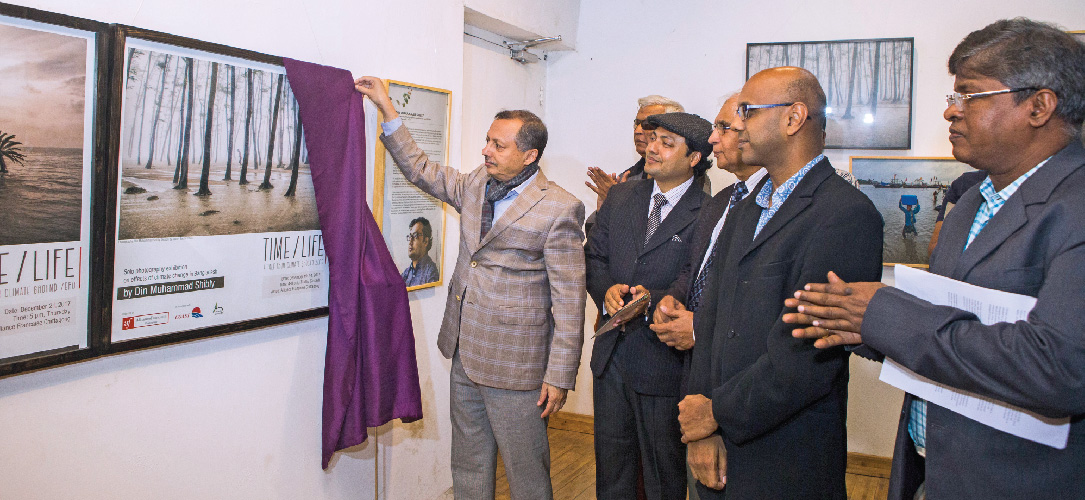
How DIN MUHAMMAD SHIBLY has encapsulated climate change throughout 15 years of his career.
Shibly exhibited his years of photography at Alliance Francaise de Chittagong. He believes that photography is timeless in capturing fleeting moments, “Photography exhibits the power to capture memories that define us, till infinity.” The exhibition, called ‘Time/Life - a Tale from Climate Ground Zero’ was held from 19 to 24 December 2017.
The exhibition displayed 15 years of his work which captured the effects of climate change. The first wall introduced the photographer by highlighting images of his feet placed at several places he visited by soaking in the essence, beauty, and nature through his senses. And the many facets of a changing Bangladesh were depicted on the many walls of the exhibit.
The second to fourth walls displayed his takes on different matters of environmental change: mourning the disappearance of rivers, turning of a harvested field into an empty land, the loss of livelihood of a farmer, the extinction of a forest, the effect of carbon emission on a city and many others. The fifth wall explicitly displayed the whereabouts of the river Padma.
Documentary photography is a concept through which a photographer foretells stories of the unexplored through his lenses, which he captured, with years of dedication. “I have witnessed the destruction caused by global warming, the catastrophe brought by climate change, and the uprooting of climate migrants from their origin. Now is the time for me to reveal some of the pale realities that people living on the bright side of nature often unnoticed” explained Shibly.
“The tentacles of a tempest wrapped around a fisherman on the lookout for Hilsha across the Padma. The uncertainty of his escape from the tide made him do anything but pray to the Almighty for survival– as such is a tale of the murky waters which provide livelihood also snatches lives,” details the artist.
He experienced the mayhem caused by cyclone Mora, the destruction of the vast Padma, catastrophic inundation of Dhaka city the drought- brought by Farakka Dam, turning of Kolatoli reserve forest into a bustle, the wreckage of ship breaking yards, and many other such manifestations.
He further explained that the river had shortened its course compared to what was there decades ago. People who witnessed the magnificent past of Padma upfront were surely the luckiest of all. His work on the Padma bears further justifies the consequence of a river emaciated by human intervention.