

By Marjiya Baktyer Ahmed
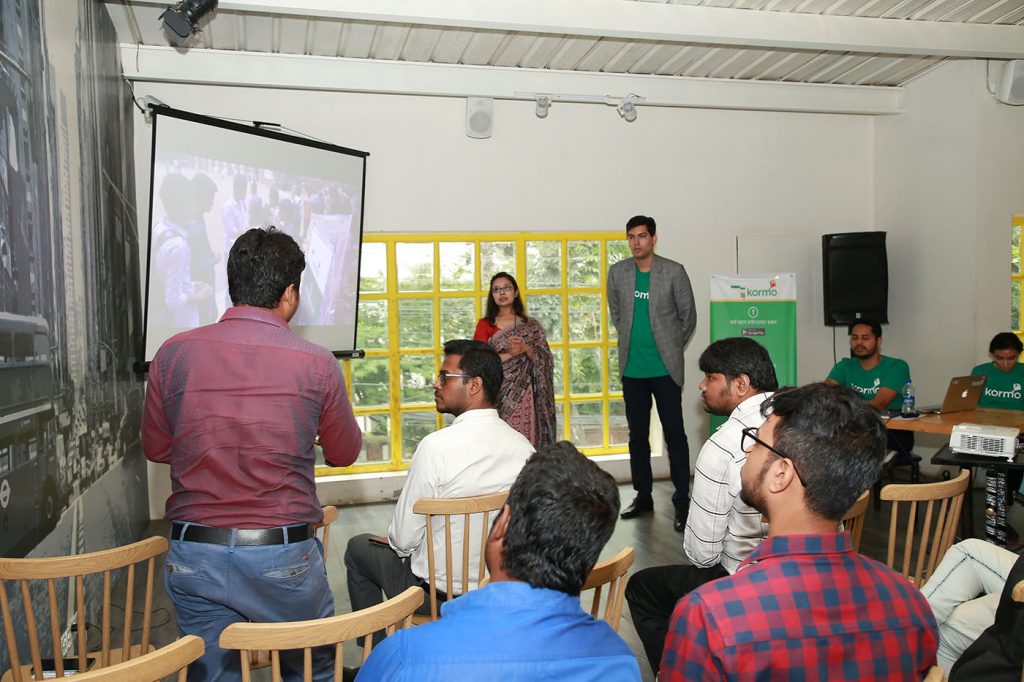
A team lead by Bickey Russel has unveiled a stealth app – Kormo – which has been quietly working to bridge the gap between underemployment and the informal job sector in Bangladesh since mid-2017. Russel explains that since its inception in Dhaka, “Kormo has successfully been able to connect more than 21,000 jobs and serve over 1,000 employers looking to improve the way they recruit”
The app’s main focus is on the “informal economy” which is comprised of unregulated forms of employment. Fixed pay, contracts and pensions are usually absent putting employees in an uncertain and precarious position. It also leaves no room to keep track of work credentials and record experience.
Kormo – or, the Bangla for “work” – stands apart from other existing job listing or matching sites, as it facilitates a constant connection with the user and takes responsibility for job fulfillment beyond the initial job matching phase. There are two parts to Kormo — the job seeker app and employer app. With the optimized algorithm, Kormo pairs candidates with available jobs based on a ‘best match’ model and provides a two-way rating system for employers and employees.
“In Bangladesh, over two million young people enter the workforce every year but unemployment and underemployment continue to grow to create new challenges for local people and the economy. With 86% of the labor force employed in the informal job sector, we believe there’s room to innovate,” said Russel.
Job seekers can sign up, create their CV and get matched to potential jobs. The app also provides curated learning content for skills and personal development. With the app job seekers can track interview attendance, successful selections, and certifications while accumulating job experience in a reliable consistent manner.
Kormo also simplifies and improves recruiting for employers. The app helps employers identify irresponsible workers by including performance ratings and references on the job seekers’ profile page. For example, job seekers who consistently fail to turn up for interviews will receive a low rating. This holds them accountable for their inaction, and employers will be able to weed out flaky job seekers earlier.
Moutushi Kabir, Director of Communication and Outreach at Brac and Brac International observes that an inclusive, transparent, and competitive digital marketplace like Kormo will enhance access to jobs and provide opportunities for the Bangladeshi youth, especially women. “Education, skills, and the job market need to be closely aligned, in order to create effective pathways out of poverty, unemployment, and discrimination,” added Moutushi, explaining that education needs to translate into employable skills and those skills need to translate into jobs.
Kormo is still in the early developmental stages, and it is currently serving over thirty different job categories in the service sector. The jobs include sales, e-commerce, and hospitality. Since its quiet launch, over 1000 companies have been posting job ads on the app.
As an online marketplace for informal jobs, Kormo caters to the younger demographic of Bangladesh who are well versed in using smartphones to search and apply for jobs. Ritesh Kumar Singh, Chief Sales Officer, Banglalink Digital Communications Ltd firmly believes that Kormo as a Google Area 120 initiative will digitally empower the youth who do not have access to potential recruiters and “provide them with a platform to find a job, which is the precondition of materializing the vision of the true Digital Bangladesh”
Kormo aims to provide structure and metrics to the informal job sector over time as the app matures. Kormo will also assist in generating economic opportunities for everyone. The Kormo app is available on Android via the Google Play store, and currently only provides its services in Dhaka.