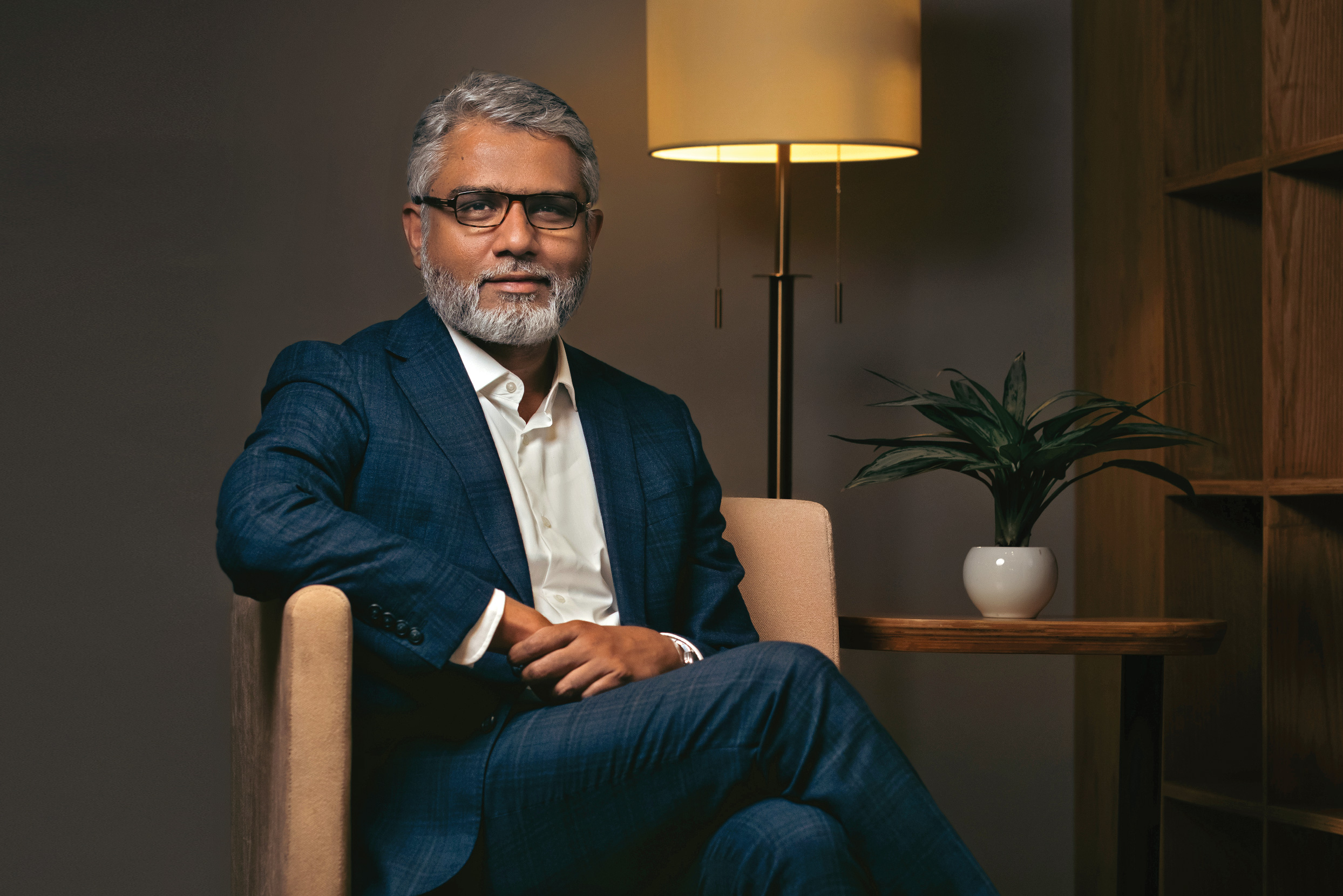
Md. Anwar Shawkat (Afser) is the President of the Dutch-Bangla Chamber of Commerce & Industry (DBCCI). He is also the Director of the Chittagong Chamber of Commerce & Industry (CCCI), and the Bangladesh Shipping Agents Association. Anwar is a member of the Federation of Chamber of Commerce and Industry (FBCCI) and Chittagong Foundation Trust and a lifelong member of the Bangla Academy. He is the recipient of a number of awards that include the Lions Club International President Award, the Mother Teresa Award, and the Jatiokabi Kazi Nazrul Islam Award.
As the president of the Dutch-Bangla Chamber, you had arranged a fair in the Netherlands after the limbo of 1st July, 2016. What was the mission behind this initiative? Why did you decide to take this drive?
We decided to hold the first international expo because the perspective regarding Bangladesh was quite bleak due to the events at the time. Following the attack, the rumors regarding the matter outweighed the facts about the incident. As the acting president, I wanted to take the initiative to restore the image of a peaceful and welcoming Bangladesh. We had sent a business delegation team that found businesses in Netherland who were interested in conducting their affairs in Bangladesh. This was during the time that the Prime Minister of Bangladesh, Sheikh Hasina, was also taking a trip to Europe; she showed further interest in holding the fair. This had led to the “General Trade Fair of Bangladesh in Netherlands”; the Dutch-Bangla EXPO-2016 took place during the 28th and 29th of September with the tagline “towards a rewarding relation”. During the expo, there were 42 participants, 70 delegates including representation from Board of Investment (BOI), Ministry of Foreign affairs (MOFA) and Ministry of Finance (MOF), international businessman, ambassadors and high commissioners. Distinguished participants included the chief guest, Finance Minister, Abdul Maal A Muhith; special guest, Guido Landheer, the Deputy Director-General of Foreign Economic Relations, Ministry of Foreign Affairs of the Government of Netherlands; and special guest, Sheikh Mohammad Belalwas, the Ambassador in the Netherlands.
What were some of the notable sessions during the program? How do you think programs such as this will impact bilateral relations?
During the Business and Investment Seminar, several presentations were given, these include: “The Bangladesh-Netherlands Trade and Investment Relations” by Mohammad Korshad Alam Khastagir, the Director General (Europe), MOFA, Dhaka; “Trade Opportunities Between Bangladesh and Benelux Region” by Roy Suhash, President Bangladesh Business Chambers of Commerce Luxembourg; “Sustainable Water Management” by Dr. M Monowar Hossain, Institute of Water Modeling (IMW); and “Investment Experience in Bangladesh” by Maarten Vebruggen, Managing Director of Deltadesh. I believe such programs are a gateway to open trade and economic relations between two nations in a mutual manner. It has provided businesses with a platform to reach a wider degree of potential clients and promote themselves on an international scale.
The foreign chambers working in Bangladesh are set to form an apex body. What are the goals and targets of this action?
The Dutch-Bangla Chamber is the first joint chamber in Bangladesh; from the beginning, we have been trying to form a forum of Joint Chambers to accomplish our targets. With the guidance of the president of the Japan-Bangladesh Chamber, Salauddin Kasem Khan, we were able to take this initiative. We started with the intention that to work on a global scale, we need to prioritize economic and business issues. Economic development is our primary concern and we want to show that other foreign chambers can contribute to our development and investment process. There are many new roads opening with increased investment, business opportunities and intellectuals expressing interest. Our goal will be further attainable once we have more than 26 joint chambers in a single unit, functioning and taking actions collectively. We want to ensure that the forum will allow for the facilitation of any connection with another part of the world.
President, Dutch-Bangla Chamber of Commerce & Industry (DBCCI)
Despite becoming a nation after Bangladesh, Vietnam has achieved greater Direct Foreign Investment (FDI). What are the challenges in attracting FDI to Bangladesh?
Bangladesh has a tremendous amount of manpower in a limited amount of land; understanding and utilizing this dynamic is of utmost importance. We can look at Malaysia as an example of training human resources in order to achieve a flourishing economy. In this context, practical and technical knowledge of the respected fields is imperative. This will change the dynamic of having foreigners take higher positions in prominent companies, allowing for Bangladeshis to have the necessary knowledge to take these positions. We must provide positions to Bangladeshis who have experience and knowledge from working abroad. Additionally, we must incorporate and entice non-resident Bangladeshis to make investments in the nation; this will result in increased inward remittance.
How can the nation overcome these challenges?
This will happen if government support is provided and we take a more active position in national projects; private sectors cannot take on this challenge themselves. If you look at the larger bridge projects, they are under the supervision of foreigners with work being done by locals. We must change this trend and allow it to become a joint venture or allow the people of Bangladesh to work independently in order to learn from the experience. In terms of foreign investment, we must have legal coverage that prevents harassment and delayed set up time of the investors. Investors are deterred by the additional informal cost of funding a project which can lead to an increase in cost by up to 25%. The nation will see greater investment when these interest rates come down. Additionally, Non-Performing Loan (NPL) bankers should be more cautious regarding the record checking of investors, and the Credit Information Bureau (CIB) by Bangladesh banks must have a database on a bank to bank basis.
Given that you have the tagline, ‘towards a rewarding relation’ and the economy of Bangladesh is changing with Special Economic Zones (SEZ) being created, what are the future projects that you have planned?
Bangladesh is receiving global attention as a result of its geographical location and strategic value. There are many interested investments from neighboring nations that include Nepal because it is landlocked. We want the nation to create multiple corridors both inland, in areas such as China and also the sea, in Chittagong, Mongla, and Payra port. We should look to become connected with these nations in the same mannerism of Europe; the continent has provisions of a roadway and other modes of transport throughout each of the countries. The success of our RMG sector has led some of the companies to establish companies in other countries; this will further utilize Bangladesh’s manpower and bring more remittance to the nation. In this regard, we want to lend our support and assistance to these companies in order to expand towards a higher international level.
What is the rewarding aspect of being a part of a business where every day is challenging?
There was a previous notion that government service was the best path in terms of a career in Bangladesh. This was broken by the success story of our generation of entrepreneurs who have generated success; their job experience in multi-national companies have allowed for business houses to flourish. For a successful business, one must work diligently and supervise everything that is being conducted in day to day operations. As a businessman, there are many hurdles that we must cross; the most apparent is the large scale corruption and legal coverage. These factors create a surmountable degree of insecurity in the business field.