An overview of the application of artificial intelligence in different areas of farming and agriculture.
With the evolution of humankind, many things have changed but the need for food to sustain life has remained universal. Starting with hunter-gatherer lifestyles, mankind started to look for some permanent solutions to their food supply. This is when the idea of agriculture began in the human civilisation and started the Neolithic Revolution back in 4000 B.C.E. As time passed, different technologies were introduced to agriculture to meet the demands for food supply. But observing the massive explosion of population in the world, a question arises – can our traditional agricultural methods keep producing enough food for our future needs?
The worldwide agricultural industry is worth around USD 5 trillion. As per the UN’s estimation, by the year 2050, the global population will rise from 7.5 billion to 9.7 billion, whereas, agricultural land will increase by only 4%. To balance out the demand and supply of food, a revolutionary step integrated into agriculture is artificial intelligence (AI). The integration is aimed at increasing global food production by 50% by the year 2050. The goal is not just to ensure the food supply for the additional 2 billion people, but also to create an effective, sustainable and easily-accessible market for the farmers.
AI technologies are playing a big role in many aspects – monitoring the soil’s condition, controlling pests, monitoring crop health, data management for farmers, and optimising productivity and yield.
BETTER QUALITY CROPS
With the help of algorithms, it is now easier for farmers to get a high-quality harvest. AI has opened a door to precision agriculture. With the technologies, it is now possible for farmers to get notified if a plant is suffering from a disease, is being infested, or is suffering from malnutrition. AI can also keep track of the health of the soil and notify the farmer if it requires attention. Aided by drone capture and computer vision, farmers can also conduct wide-area surveillance of their land. Essentially, AI is directly contributing to the improvement of crop quality. As per BI Intelligence Research, Global investment in AI is expected to increase revenue three times by 2025, which is estimated to be almost USD 15.3 billion.
REPLACING MANUAL LABOUR WITH AI
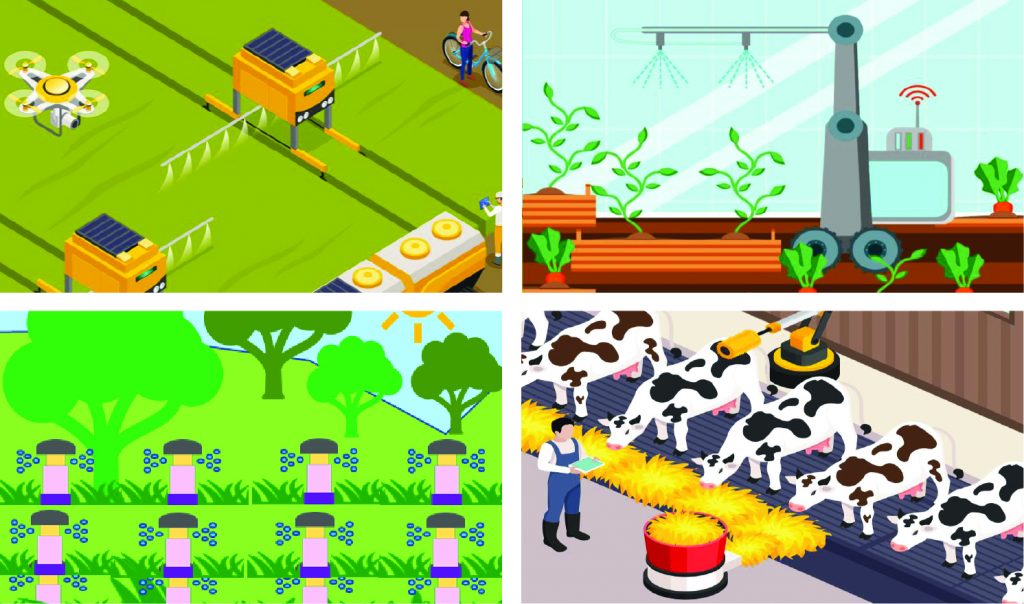
In the era of urbanisation, the portion of the population interested in agriculture is decreasing day by day. Agriculture is not getting enough social and financial recognition as a profession and modern facilities of urban life are attracting harvesters to move into cities. As a result, manual labour in this sector is decreasing day by day. The shortage of workforce is especially evident when it’s high time to harvest. AI can be used to address this gap. AI agriculture bots can be an alternative to traditional labour. These technologies can maximise productivity, as they can harvest a huge quantity of crops at a higher pace than manual labour can. Not just that, the computerised bots are above human errors and can deliver more accurate results in a shorter time. Harvesters can use drones to capture images of the whole farm and analyse any existing spots for improvement. The bigger scenario provides clearer data and allows harvesters to make better decisions. Additionally, real-time video streaming has allowed specialists a wide range of data that were previously out of reach.
SEASONAL FORECASTING
In the sector of agriculture, one must always be ready to face future disasters. Precautions taken to tackle upcoming troubles can minimise losses. AI has brought about a revolution through seasonal forecasting models. The models analyse the weather trajectory of the region and can use that to predict upcoming natural events. As a result, the models can prevent would-be damages to farmlands and crop production to a great extent. The models can be especially crucial for small farms in developing countries as they provide an optimum mechanism that best utilises limited available data.
SMART SENSORS
In-ground smart sensors can be paired with AI-supported agricultural systems to provide data that were previously inaccessible to farmers. The smart sensors keep readings of the soil moisture, fertiliser amount and nutrient levels. Using the data, a processor can analyse how the crops develop in current soil conditions. Based on the data and its analysis, AI systems are able to suggest possible solutions to specific problems. The process can be trained and setup to be autonomous with minimal human interventions, contributing to a more efficient agricultural workflow.
TRESPASS DETECTION
AI can significantly help in crop conservation through trespass detection. The advanced technology can keep fields protected from unwanted guests – be it insects, animals or humans. The combination of AI and machine learning offers a highly efficient perimeter protection system. Cameras, sensors, and heat signature detections can detect burglaries, break-ins, animal crossings and insect flights – all of which can be a huge distraction to farmers if done manually. The system can be trained to identify scenarios that constitute an intrusion and can alert the farmer.
HARVEST PLANNING WITH YIELD MAPPING
Yield Mapping or Yield Monitoring has made it possible to predict crop yield in specific areas of the land through the utilisation of GPS data. 3D mapping of the land paired with soil-colour analysis is used to forecast the potential yield of a land segment even before a harvesting cycle begins. Yield Mapping can also indicate when a piece of land needs to be watered, or alert that it may not be suitable for farming at all. The mapping technology, therefore, works great in helping planners to make strategic decisions that would work best for their fields.
GUIDANCE ON PLANTATION
Farmers are faced with the decision to choose between crops that are most likely to be profitable. Traditionally, these decisions were made based on experience and intuition. AI facilitates this process by providing suggestions at high-confidence levels of the ideal crop for profit maximisation. Through a process of data collection using humidity and temperature sensors, and data analysis aided by AI, farmers are able to minimise risks and losses from unsuccessful yields.
A GREENER EARTH
The negative impact of the overuse of pesticides is well known. It can cause water pollution and soil damage and can also be harmful if ingested. Organic cultivation is therefore becoming more popular. AI in farming is the next step toward organic cultivation. For example, a US-based AI firm called See & Spray claims to have a machine that is able to differentiate between plants and weeds, which can potentially reduce the use of herbicides by up to 90%. Examples of AI utilisation in farming can also be taken from the Netherlands. The country has been successful in introducing a more environment-friendly model in cultivation that has minimised the usage of pesticides in crops, ensuring a better world for future generations.
I undoubtedly brings the blessing of a sustainable solution that not only delivers better results in a short period of time but also is environment-friendly. It is highly unlikely that traditional farming methods will continue to sustain the global rising demands for food. The role of AI in facilitating food supply is therefore unquestionable. However, the question that does arise, is what happens to the farmers, particularly in underdeveloped and developing countries who continue to rely on traditional farming methods. This question has its validity, especially in the context of Bangladesh. To make Bangladesh a part of the agricultural revolution, the government has to train and support farmers in using AI. The training and financial help will make the algorithm-based methods accessible to the mass, ensuring that no one is left behind. This can be a great initiative to make the youths interested in the agricultural sector again.