Unfolding what went wrong in Pakistan over just a few decades that its economy now teeters on the brink of economic collapse.
Despite being in a better position than Bangladesh after the 1971 war and its consequent surrender in it, the Pakistani government was unable to capitalise on its advantageous position and keep its growth trajectory up. While it did emerge as the country that was better off out of the two in terms of infrastructure, finances and world recognition, the People’s Party of Pakistan, led by Zulfikar Ali Bhutto was largely powerless to stop corruption from shooting up, turning a convenient blind eye to the malpractices of some select elite who were covertly providing access to state corridors to amass private fortunes for themselves. The nationalising spree from the 1970s did nothing beneficial for the country either, as nationalised industries increasingly showed losses owing to bad decisions. Bhutto’s government instead, led the Pakistan of the 1970s into income inequality and inflation.
Bouncing back in the 1980s, owing to deregulation, and remittance and foreign aid from ex-pat workers, Pakistan managed to liberalise or abolish a number of controls on industry, keep the balance of payments deficit under control and become largely self-sufficient in all basic foodstuffs, except for edible oil. The GDP of the country rose, the nation saw unprecedented agricultural and industrial growth, and cash going from The United States through Pakistan and into Afghanistan further fuelled the local economy. Under Prime Minister Muhammad Zia-ul-Haq, the economic policies of the country became more market-oriented and less socialist.
However, this growth proved volatile as Pakistan lost steam again in the 90s under political duress, with the country oscillating between Bhutto and Nawaz’s governments. GDP fell sharply and the country was embroiled in fiscal and external deficits. It lost its position in the world trade arena, and as poverty almost doubled from 18% to 34%, the Human Development Index (HDI) of the United Nations Development Programme ranked the country as one of the lowest development categories of the time.
A military coup by General Pervez Musharraf in 1998, came as something of a breather to Pakistan. Pervez took over when the nation was heavily indebted, with a high fiscal deficit and a low capacity for revenue generation, ridden with poverty and joblessness, and a weak balance of payments. Between 2002-2007, he took Pakistan through a period of growth. With sound structural policies and improved economic management, he created around 11.8 million jobs, pulled up the county’s GDP, increased investment rates and roped in foreign private capital. The country was flourishing, as compared to how Musharraf had found it – in shambles.
Mired by coups, assassinations and planned agendas against running prime ministers, the country now grapples with stagflation, unemployment, a lack of basic amenities such as gasoline, water and electricity, food shortages and a foreign reserve fund that has dwindled to negative figures.
Unfortunately, once he stepped down, the country saw a rise in violence and crime rate with each passing government. What is amazing about the democracy of Pakistan is that no Prime Minister has ever successfully completed a full term in the country. Mired by coups, assassinations and planned agendas against running prime ministers, the country now grapples with stagflation, unemployment, a lack of basic amenities such as gasoline, water and electricity, food shortages and a foreign reserve fund that has dwindled to negative figures.
One may argue that much of this is a direct consequence of the recent pandemic and the ongoing war between Russia and Ukraine. But, more so than that, experts feel that it is the excessive borrowing that Pakistan has piled up, over a number of years that has resulted in defaulted payments, and a fall in the local currency, and is the reason why imports have become more and more expensive in relative terms. Yousuf Nazar, a Pakistani economic analyst and former banking executive opined, “This present crisis was brewing long before the Ukraine war.”
According to Indian strategic affairs specialist Sushant Sareen, Pakistan has doubled its debt every half a decade or so, over the last 25 years. When General Musharraf held the reigns for Pakistan, the country had a debt of PKR 3.06 trillion. By the time Imran Khan stepped down in the year 2022, the debt figures stood at PKR 62.5 trillion. It was not just the borrowing that did it for Pakistan. While debt grew at an average of 14% a year, the country’s GDP only grew at 3% annually. This created a situation where the debt burden was proving to be unsustainable for the country. In the fiscal year 2022-2023 for example, the debt servicing figure for the country stood at PKR 5.2 trillion, exceeding the revenue for the entire federal government.
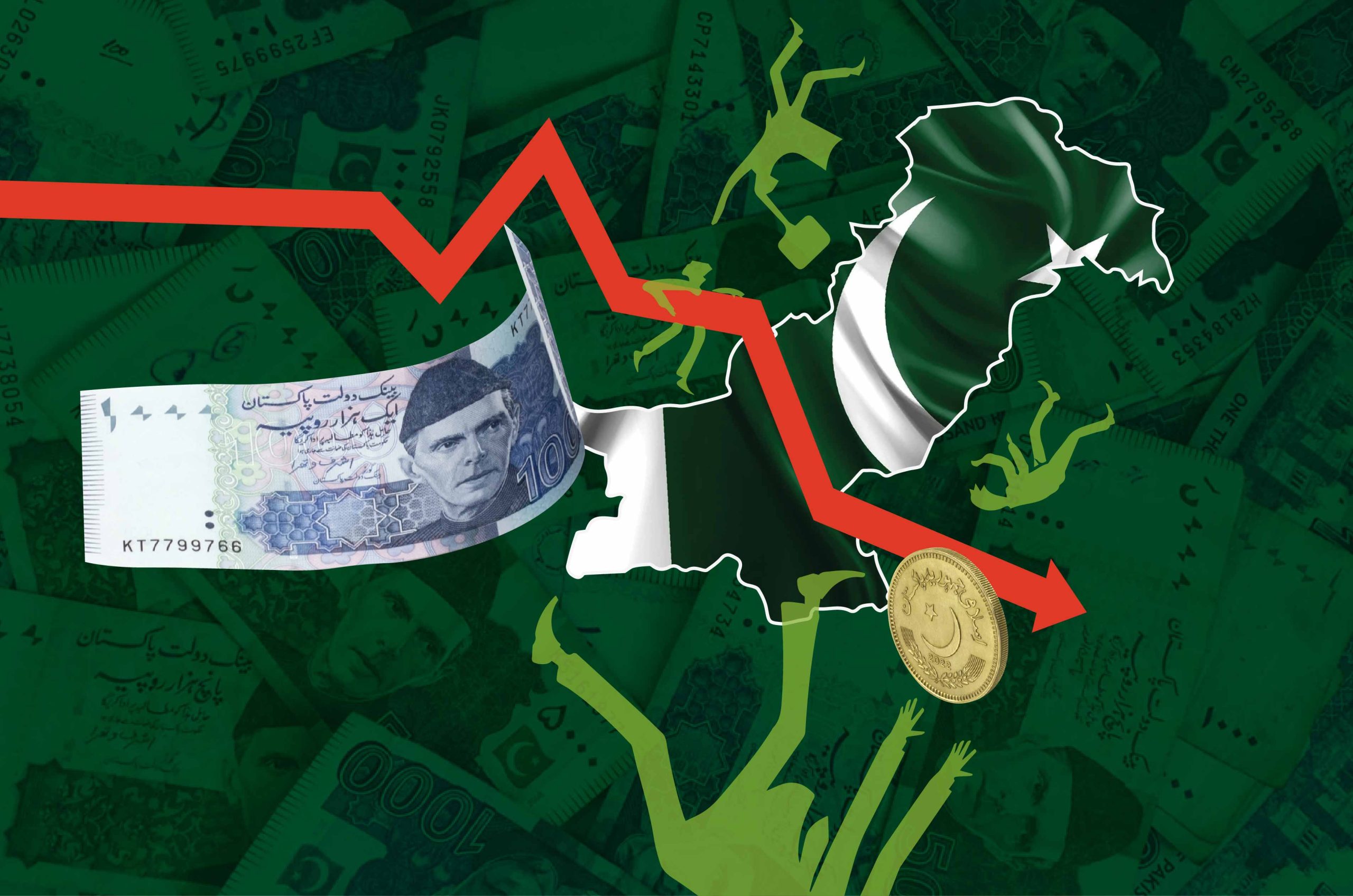
Short-term, almost frantic measures taken to conserve diminishing forex reserves in 2022 included shutting down businesses and factories to conserve electricity and banning imports of unnecessary, luxury items. The current Prime Minister of Pakistan, Shehbaz Sharif mentioned in one of his meetings that the country would have to “pursue austerity.” In the same year, the cap on fuel prices was finally lifted. Lifting this cap was one of the many long-standing conditions put forward by the IMF. Other conditions include raising electricity prices in Islamabad, radically amping up tax collection, making significant budget cuts and cutting off subsidies and export tax rebates for larger firms and cartels. Ahsan Iqbal, the Federal Minister for Planning and Development has even suggested cutting down on tea consumption in the country. Tea is consumed at an alarming rate in Pakistan and most of it is imported at credit. Import figures for tea stood roughly at USD 640 million during the pandemic in 2020.
To make matters worse, climate change has recently not been a friend to the people of Pakistan. The floods in the summer of 2022 resulted in USD 30 billion in economic losses across the country, adding to the plight of the common people. Inflation, which at one time may have appeared to be creeping, is now galloping at full force and is proving to be an unwarranted tax on the poor and middle-class sections of the country.
As the capital is set to default on the current instalment of the national debt, volatile politics between Imran Khan’s Pakistan Tehreek-e-Insaf and Shehbaz Sharif’s Pakistan Muslim League (N) have delayed any logical response by the government. Khan’s dramatic ousting has been termed a ‘political soap opera’ and the youth of Pakistan seethes as the former Premier struggles to make a comeback.
Amid natural catastrophes, political paralysis, economic hara-kiri, and skyrocketing inflation, Pakistan’s story may well be a real-life series of unfortunate events. This moribund state of the economy has the most optimistic experts worried. Pakistan still waits for the IMF bail-out, but the global lender has been stern so far. Saudi Arabia, which has, on many previous occasions, helped its fellow Muslim nation out, also seems reluctant to loosen its purse strings this time, asking for internal reforms. Even China, holding around 30% of the country’s debt has shown no signs of renegotiating terms.
If the worst comes to pass, there may be 220 million refugees out in the world, complete with nuclear power and weaponry. It was not an ideal situation for the world when the Syrians and Libyans had walked. Pakistan is predicted to be a whole new wave altogether, and much more consequential to the world.
Other experts warn that such a crippling shortage of amenities for the citizens of the country could have extremists like the Pakistani Taliban targeting the government directly. The radical body has already announced its return with a bombing that killed 89 people in Peshawar. Uzair Younus, the director of the Pakistan Initiative at the Atlantic Council’s South Asia Centre cautions that the world could see the state weakening considerably, compromising its ability to impose order. He calls this triangular crisis “the worst threat to Pakistan’s national cohesion since 1971.”
Pakistani forex reserves are shallow, and the country is unable to sustain even a week or two on its current monies. Electricity blackouts across the country have perplexed citizens, especially at a time when inflation has hit 40%. To many, Pakistan is a compounded crisis, plagued by a weak government and a kleptocratic elite. When the rest of Asia was taking advantage of the wave of globalisation and liberalisation in the 1990s, Pakistan was embroiled in power struggles with its army, playing a botched game from the beginning.
In a harsh comparison with ‘enemy’ India, Michael Kugelman, deputy director of the Asia Program at the Wilson Centre says that up until the 1980s, Pakistan actually had a better growth chart. However, where India moved towards inclusive policies similar to universal education and healthcare, Pakistan’s powerful simply let the economic divide widen. As a result, as other Asian countries have progressed and evolved over the decades, Pakistan has remained poor and unstable.
Despite fierce differences, the political parties now seem to be working towards the common goal of bringing the country back from the brink of disaster. Ex-President Asif Ali Zardari, notorious for his outrageously corrupt practices, remains hopeful as he once reportedly told U.S. diplomat, Richard Holbrooke, “Pakistan is too big to fail.” The world waits to see if his optimistic prophecy will come true or whether this nonchalance will be the straw that finally breaks the camel’s back.