


Page 90 - ICE BUSINESS TIMES March 2020
P. 90
Urban Planning
The First population. The evolution of Bazaars
as the growth center for trade and
commerce, and transportation hubs
are also briefly described.
Town Plan The second chapter talks briefly about
the need and significance of a survey
of the old town, especially along the
Dholai Khal (mentioned as a great
Part 1
natural moat) domination of Bara
of Dhaka Katra and Choto Katra, some temples
and mosques, all other civic facilities
like sanitation,institutions and
connections with major facilities by
roads and railways. Moreover, he
recommended that the survey outputs
should be displayed on the walls of
the City Council, Municipalities, Public
Health, Medical School and in
neighborhoods so that the general
public can participate and voice their
opinion.
The third chapter deals again with an
in-depth survey of the old town,
especially Wari, Thana W. C. area,
main streets and esplanade and
Report on Town improvements of Shakhari Bazar area
Planning, Dacca (a heavily congested area even back
(1917) then). Furthermore, criticism of the
So, what was exactly in the report by encroachment of 18-20 acre of land by
Prof. Patrick Geddes? As mentioned courts, municipal offices, college,
above, the report was the first known schools and missions. He also
initiative of town planning for Dhaka. described and provided how to
It is organized in several chapters on improve the main thoroughfare by
important components and distributing the traffic load towards
subsequently divided into smaller Panitola. He wanted to propose a
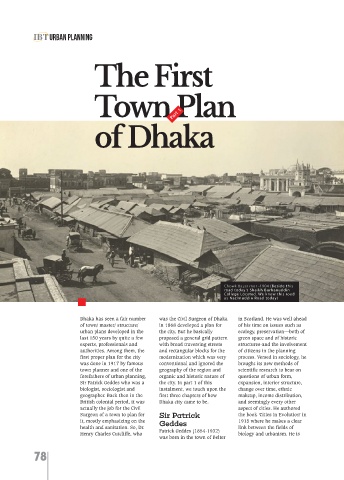
!"#$%&'()(*&+#*&,-./0&(Beside this East-West connecting tram line but
road today’s Sheikh Burhanuddin subsections. He clearly mentioned
College Located. We know this road that, town development plan should wondered about the narrow streets.
as Nazimuddin Road today) Sir Patrich Geddes was indeed a
always be seen from a wider
called the “father of modern town perspective. It must include the futurist.
planning”. As Pierre Clavel writes in socio-economic wellbeing of the
Dhaka has seen a fair number was the Civil Surgeon of Dhaka in Scotland. He was well ahead his introduction to a 1971 reprint, inhabitants with respect to aesthetic
of town/ master/ structure/ in 1868 developed a plan for of his time on issues such as Geddes: Stay tuned to learn more how the cityscape
urban plans developed in the the city, But he basically ecology, preservation—both of “began as a biologist, spent a fruitful and environmental benefit. City wonder that is Dhaka came to be and has evolved
since in Part 2 in our next issue.
planning is not simply about the
last 150 years by quite a few proposed a general grid pattern green space and of historic but largely unreported middle period
experts, professionals and with broad traversing streets structures-and the involvement as a university and civic reformer, and infrastructures, rather it’s about the
people living there.
authorities. Among them, the and rectangular blocks for the of citizens in the planning then began, in his 50s and 60s, a
first proper plan for the city modernization which was very process. Versed in sociology, he highly visible and international public In the very first chapter he introduced
the idea of a physical model for
was done in 1917 by famous conventional and ignored the brought its new methods of life with an increasing focus on city
town planner and one of the geography of the region and scientific research to bear on planning.” Bengal Delta, not only for the city. He
took the whole river system to
forefathers of urban planning, organic and historic nature of questions of urban form, The planner was invited by the
Sir Patrick Geddes who was a the city. In part 1 of this expansion, interior structure, Governor of Madras to advise on perceive the riverine connection to
Dhaka with other peripheral regions of
biologist, sociologist and instalment, we touch upon the change over time, ethnic emerging urban planning issues and
geographer. Back then in the first three chapters of how makeup, income distribution, to develop a few strategic plans for the East Bengal. He described the
geographical features and later
British colonial period, it was Dhaka city came to be. and seemingly every other towns in the Indian subcontinent. In
actually the job for the Civil aspect of cities. He authored the end, between 1915 and 1919 defined how the natural drainage
system of the city was determined by
Surgeon of a town to plan for Sir Patrick the book ‘Cities in Evolution’ in Geddes wrote a series of "exhaustive
it, mostly emphasizing on the Geddes 1915 where he makes a clear town planning reports" on at least numerous Khals (canals), ponds,
ditches and marsh lands and how they
health and sanitation. So, Dr. link between the fields of eighteen Indian cities, Dhaka was a
Henry Charles Cutcliffe, who Patrick Geddes (1854-1932) biology and urbanism. He is meet their end accumulating the
was born in the town of Belter part of that initiative. rubbish from ever increasing
78

