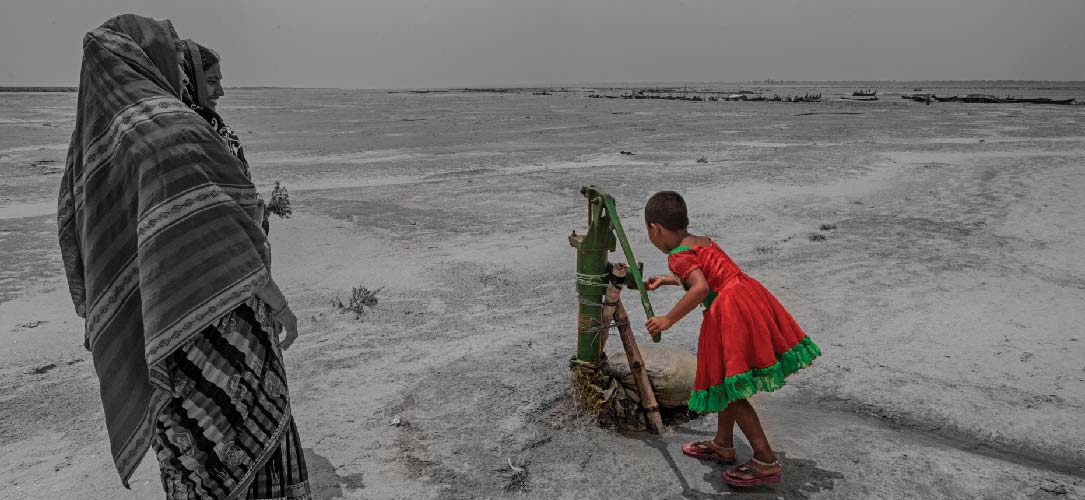

Water is one of our most critical resources in the world– even more important than oil. A recent report by the Intergovernmental Panel on Climate Change (IPCC) states that global warming will lead to “changes in all components of the freshwater system.” They concluded that “water and its availability and quality will be the main pressures on, and issues for, societies and the environment under climate change.” Scientists and environmentalists are warning that water scarcity could become a grave issue as it hinders economic growth, leads to forced migration and creates significant and uneven consequences across the globe. Global warming has already begun to show how it can impact the world’s water.
Countries such as Bangladesh are likely to be hit hard by the environmental phenomenon, which will bring abnormal weather conditions such as droughts, salinity intrusion, etc. which will lead to severe water shortages, contamination and affect agricultural output and food security.
In 2009, Cyclone Aila hit Bangladesh and damaged most its water infrastructures and contaminated its surface water sources in the country’s South Western region. In most areas, tube-wells don’t work because of salinity in the shallow and deep aquifer levels, leaving most people dependent on surface water for drinking and cooking.
Although seven years has passed, the government is yet to restore freshwater sources in the country’s coastal belt. This is primarily because of lack of water flow in rivers, which contributes to the rise of salinity.
A World Bank report in February 2015 indicated that climate change is likely to increase river salinity leading to shortages of drinking water and irrigation and significant changes in aquatic ecosystems in the Southwest coastal areas during the dry seasons by 2050.
Increased rural to urban migration has placed significant pressures on urban food and water resources. Urban groundwater is being extracted faster than it is being replenished. In Dhaka, 87% of water used each year is obtained from groundwater resources, and although many homes have access to this resource, it is unsustainable in the long-term. In 2010, troops were called to guard pumps during an acute water shortage in Dhaka. The deficit was caused by a lack of rainwater and was exacerbated by regular power outages. This highlighted the heavy dependence on groundwater resources and the urgent need for investment in water infrastructure to meet future demand. More sustainable water management is required to facilitate migration from rural to urban areas.
Declines in water availability and quality can increase competition for clean water. In water-scarce regions, tensions can arise between businesses and local communities, particularly in developing countries where local populations often lack access to safe and reliable drinking water. Community opposition to industrial water withdrawals and perceived or real inequities in water usage can emerge quickly and affect businesses profoundly. Local conflicts can damage brand image, or, in rare instances, even result in the loss of companies’ license to operate. In Kerala, India, for example, both PepsiCo and Coca-Cola’s bottlers lost their licenses to use groundwater, after a drought spurred community dissension and increased competition for local aquifers.
Water scarcity is driving shifts toward full-cost pricing aimed at providing economic incentives for efficient water use. In many places, artificially low water prices are rising as subsidies are phased out. One would expect urban and higher income populations to spend more than the rural and lower-income people on food, housing, water and sanitation. But for drinking water at least, the scenario in Bangladesh’s coastal districts is quite the opposite. Dhaka Water Supply and Sewerage Authority (WASA) provides water for household use to the city residents at the rate of Tk 8.49 for per unit (1,000 liters). Khulna WASA charges Tk 4.50 for the same volume of water to its city’s inhabitants. However, people living 20 km south of that town have been spending Tk 10 for 20 liters of drinking water as they have to remove salt via treatment plants. It is the same scene in most places across the 19 coastal districts. The salinity in land and water defines the lives of humans and all other creatures. To ease the situation and provide fresh drinking water to the coastal population, different government and non-government organizations have been setting up various types of interventions. These include excavating ponds, creating pond sand filters (PSF) and reverse osmosis filter technology.
Bangladesh needs to be fully prepared to tackle climate change and the major issues that will come with it, water scarcity and salinity intrusion being the primary sector that will be affected. While it is essential to understand macro changes in South Asia’s climate and water ecosystems, good water management also requires an understanding of local dynamics in areas dependent on river water, including grassroots perceptions of water-related challenges and modern views about their causes. The importance of public consultations is often acknowledged, but the consultation processes are challenging. The involvement of water user associations and NGOs in public discussions or as non-voting participants in institutional bodies can significantly enhance the quality of decision-making as well as the implementation of policies for sustainable integrated water management.
Photograph by Din M Shibly
The writer is a Senior Research Associate working at Policy research Institute and can be contacted at mehrin.karim07@gmail.com.