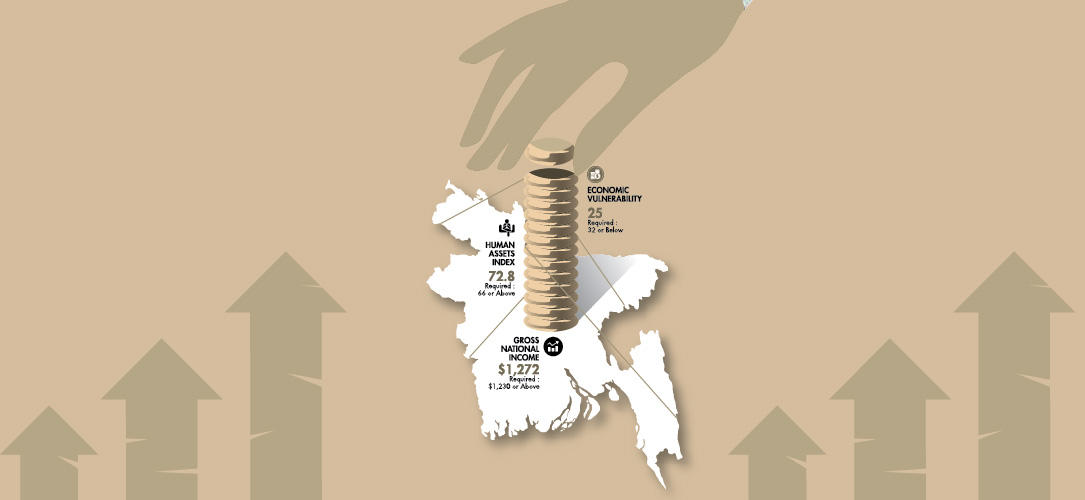

Along with the birthday of Bangabandhu, the Father of the Nation,17 March 2018 presented us with a major milestone for our country. Bangladesh has added its name to the Developing Nation’s list and its new shift of status from (Least Developed Country) LDC. It’s important to examine whether the recent trend of an increasing number of LDCs graduating or becoming eligible for graduation will continue in the medium term. To do so, however, we must address several methodological issues related to the current criteria that categorize countries as LDCs, which consists of gross national income (GNI) per capita, human asset index (HAI) and economic vulnerability index (EVI).
CONQUERING THE CRITERIA
The threshold GNI per capita for graduation is currently set at $1,230 or above. This threshold is actually an average of the previous three years’ income. The HAI is set at 66 and EVI is fixed at 32. While a country must attain higher than the threshold values in the case of the first two criteria for graduation, it must be below the threshold in the case of the third criterion. All three criteria (slightly different from those used for inclusion in the group) have been met by Bangladesh. According to the UN Conference on Trade and Development (UNCTAD) report, 2016, an LDC can graduate if it meets two of the three criteria or on the basis of the income paradigm if the country’s income doubles. The UNCTAD report said the graduation is the first milestone in a marathon of development, not the winning post of a race to escape the LDC category. Thus, the LDCs, which have already included graduation as one of the main policy agendas, will have to create a momentum to sustain the economy post-graduation. Graduation would also mean the countries would be stripped off of all the preferential treatments and support mechanisms being granted by developed countries. The countries must fulfill the graduation criteria as well as structurally transform themselves as a competitive economy resilient enough to stand their ground on their own.
At present Bangladesh has met all three criteria. The income threshold for graduation requires an average of $1,230 or above and Bangladesh’s progress in this respect amounts to $1,272, making the target fulfilled. In terms of EVI, Bangladesh has been shown to have scored 25 against the required 32 or below, thus fulfilling the target. The EVI covers both external trade shocks and environmental or natural shocks. The latter include natural disasters, weather shocks unfavorable for agriculture production and permanent shocks caused by climate change. Both trade and environmental shocks potentially affect economic activity, consumption, employment, the well-being of the population, and the natural resource base of economic and social development. Moreover, these shocks are exogenous from the perspective of LDCs, even though the frequency and magnitude of trade shocks and environmental shocks, such as climate change, are dependent on those policy choices made at the international level to some extent. Bangladesh has been actively engaged in climate change and other trade-related policies which have contributed to the achievement of the EVI.
The third criteria, HAI, fixing 66 or above as the target and Bangladesh having scored 72.8, is also on target. As HAI indicators are measured in different units, indicator values are first converted into index scores between 0 and 100. The HAI is a measure of the level of human capital, low levels of which are considered to be major structural impediments, not only because they are a manifestation of unsustainable development, but also because they limit the possibilities for production and economic growth, prevent poverty eradication, exacerbate inequalities and hamper resilience to external shocks. The HAI consists of four indicators, two on health and nutrition and two on education, each one having an equal weight in the overall HAI. The HAI reflects the average of the index scores of the four HAI indicators. A higher HAI index represents a higher development of human capital. Bangladesh is doing well in terms of mortality rate (80.5%) and prevalence of undernourishment (81.2%), while also achieving a literacy rate of 72.76%. The massive infrastructure program and expansion of utilities, particularly generation of electricity embarked upon by the government with local and external resources has been the pillar to create the conducive environment for accelerated investment that is required for GDP growth on a sustained basis.
The Changing Dynamic of the Way Forward
Although a country is provided with a breathing time of three years upon graduation to continue with the preferential treatment it received as an LDC, the shock of higher duties in accessing the already prevailing markets due to lack of preferential access may be overwhelming. This implies that if Bangladesh graduates in 2024 and shed its LDC identity, it will retain all the privileges it enjoys under the current arrangement until 2027 to facilitate a smooth transition. This move from LDC status will definitely bring about some advantages and disadvantages of graduation.
One benefit of moving from LDC status is the ability to bring the country to a higher level of reverence. As the progress rate increases, Bangladesh can’t always reap the benefits of LDC, therefore making the shift from LDC lead to a higher stature for the country. As a non-LDC country, Bangladesh will not be eligible for a grant or concessionary loan. The reduction in the volume of grant and loan will have to be compensated through increased volume of export earnings and remittances by migrant workers. To achieve the latter, highly skilled labors have to be sent abroad with simpler and more affordable ways of migration. The adjustment process may be dilatory, for which the ‘grace’ period of three years after 2024 should be sufficient.
In retrospect, we must continue to strive for progress and attempt to retain this momentum with a united effort from all sectors. It’s our responsibility as citizens of this nation to make our country safer and more sustainable for ourselves and for the generations that will follow us.
The writer can be reached at mehrin.karim07@gmail.com