
By Hasnat Soyeb
On June 9, 2016, BBC Bangla broadcasted a report: “A separate league with asylum seekers of Denmark are under planning. The goal of this is to make sure the asylum seekers may mix with the rest of the society. Asylum seekers of four shelter centres in East Denmark will take part in this league.”
While I was thinking about it, my imagination was flying with its wings. 17 years ago, when I was ten, or even a couple of years before that, we came out of Plato’s ideas and started to play football with real balls. Before that, we used to play with balls made by rolling papers or using the peel of citrus fruits (locally known as Jambura). Perhaps most of us had a similar kind of childhood. We made friends, and sometimes even enemies while playing football. There is a slight similarity between our story and the story mentioned above. Using football to socialise with political asylum seekers may sound unique, but our mind is affected by this sort of hegemony. If we put ourselves in the centre of the text, we will understand that we are becoming worthy of society through our appearance on the playing field. However, I would like to consider football to be synonymous with theatrical plays on stage. Throughout history, football has been a tool in politics on many occasions. Its button has always been under the control of the ruling class. Till date, most political uses of football has been made by military governments. Let us take this into consideration.
“THE IDEA THAT POLITICS AND SPORT SHOULD
BE KEPT APART IS LAUGHABLE IN ITALY”
– Benito Mussolini
I was unfortunate enough to not have been born before the World Cup of 1978, as I was unable to witness one of Argentina’s two World Cup wins. Argentina’s former military government under the ruling of General Videla made dirty use of the tournament. He made a blueprint to win the coveted trophy by any means necessary just to establish his dictatorship. His goal was to provide an alluring incentive to his people so that they indulge in it and refrain from taking a stand against this tyranny. What could be a better option than a World Cup to fulfil his desire? He could successfully utilize the World Cup of 1978 to prolong his reign. Let us put some light on the World Cup of 1978.
Eduardo Galeano, in his monumental book Soccer in Shadow and Sun, said that while Videla was inaugurating the 1978 World Cup, naval machines were being used to run a concentration camp in a school just a few blocks away from the stadium. Prisoners were being sent alive into the sea located within a few miles from the venue. Unfortunately, football overshadowed these oppressions.

In that tournament, there was no quarter-final or semifinals. Eight out of the 16 teams would qualify for the next round. Those eight teams were divided into two groups and the top teams from each group competed in the final. South American rivals Brazil and Argentina were in the same group and were standing with the same three points before the final group match. Argentina’s last match was against Peru, while Brazil had to play against Poland. Both matches were supposed to start at the same time but Brazil’s match took place three hours earlier and they won by a margin of three goals to one. With that result, Argentina needed to win by a five-goal margin against a strong and capable Peru. Remarkably, the hosts accomplished the difficult feat by winning the match with a score of 6-0.
However, it was suspected that Videla’s military junta had a secret deal with Peru’s Francisco Bermudez about the outcome of the game. After a few decades, on February 10, 2010, a report was published in the British newspaper Daily Mail, where Peru’s former Senator Genaro Ledesma confirmed in a Buenos Aires court that the match was fixed by the dictatorship of two countries.
Moreover, there were allegations that a night-long concert, tantamount to the cacophony, was arranged in front of the hotel of Nederland players before the night of the final game to cause disturbance and prevent them from sleeping. Despite being the defending champions and the best team during that era, Nederland lost the final. However, their players refused to salute the junta to show how football is deeply embedded with a political spirit. They might not have defended the trophy, but they turned the saying ‘keeping sports away from politics’ into an insubstantial one.
Talking about dictators, let us recall the most heinous one, Adolf Hitler. He annexed Austria and the phenomena, known as ‘Anschluss’, was a big triumph for the Nazi leader to boost his bid for Aryan supremacy. However, a footballer named Matthias Sindelar showed open discontent of this annexation by declining to play for the ‘unified’ team. The social democrat, known as ‘Mozart of football’ for his prowess, even showed the audacity to score against Hitler’s team. In 1939, he was found dead in a hotel room.
The rivalry between Celtic and Rangers has even become a sectarian one on many occasions as the former beholds the Catholic faith and the latter Protestant.
Everyone knows football has been the epitome of passion, especially the impact of Swadhin Bangla Football team in our war for Independence before cricket took the centre stage across the nation. On July 24, 1971, the team took to the field to play against Krishnanagar XI at the Krishnanagar Stadium in the Nadia district of West Bengal. The match ended with a score of 2-2, but the impact of the match was far greater. Controversy arose due to Bangladesh being allowed to play, as the independence of the country was not recognized till date. The district commissioner of Nadia was suspended and Indian Football Federation (IFA) scrapped the associate membership of Nadia Football Association. But the flame of Bengal nationalism could not be doused.
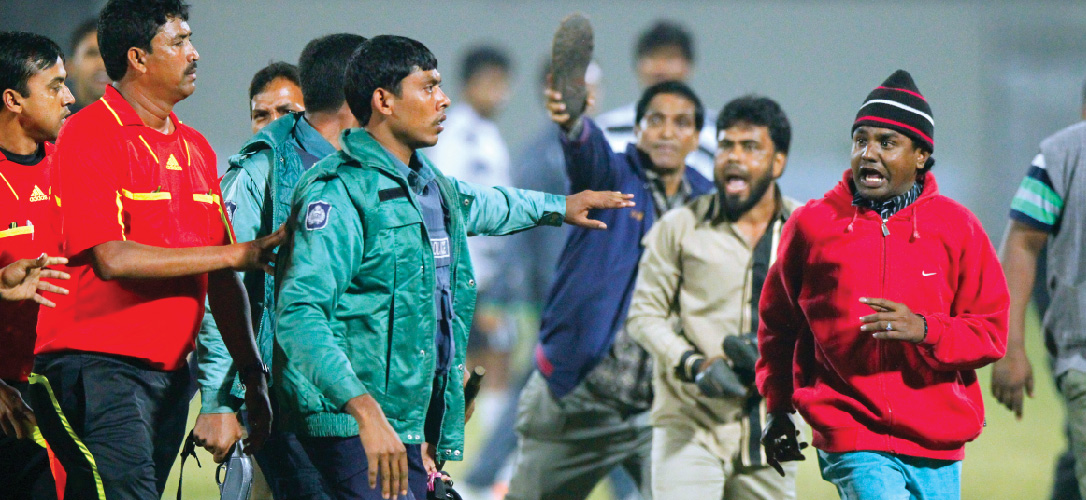
Hooliganism is not simply a word in the dictionary of football, but often it has crossed limits to the extent of taking lives. The hooliganism between rival clubs has always been pervasive. Some of them, like the Scottish rivalry of Celtic v Rangers, as well as the rivalry between Chelsea and Tottenham, can sometimes prove to be significantly toxic. The rivalry between Celtic and Rangers has even become a sectarian one on many occasions as the former beholds the Catholic faith and the latter Protestant. There are thousands of books about hooliganism but one little slogan would illustrate how deep the hatred truly is. Rangers supporters sing ‘F**k the pope’ throughout the game to show their wrath. The hatred of the two sects may have diminished otherwise, but it is still somewhat prevalent in the world of football.