
Satkhira, despite inducing wrath of cyclone Aila, rehabilitates itself for tourism prospects
By Saad Mahmud
Satkhira district is located in the south western part of Bangladesh. Satkhira region was once a part of the ancient Banga Janapada. The previous name of Satkhira region was ‘Satgharia’ (established by Zamindar Pran Nath Roy Chowdhury). In 1781, most of the areas of Jessore, Faridpur and Khulna were brought under a single administration. But while peasant movement spread over the region against the oppressions of indigo planters and the local landlords in 1801, the British East India Company established a subdivision at Satgharia under Jessore district to control indigo revolt and to strengthen local administration in 1861. By this time ‘Satgharia’ turned into ‘Satkhira’ in the records of the British Company. After the liberation of Bangladesh, the subdivision was turned into a district in 1984.
Disaster Inc
On 25 May 2009, Satkhira was struck by Cyclone Aila causing extensive destruction across 11 coastal districts, killing 190 people and affecting more than 3.9 million. The two worst-affected districts were Shatkira and Khulna where more than 300,000 people have been affected with their homes and livelihoods destroyed. The cyclone also caused a tidal surge destroying parts of the embankment in Khulna and Shatkira and flooding large areas.
After the disaster, even though it was deemed as one of the poorest regions of Bangladesh, it was devastated even more. The regional economy collapsed and the affected population needed extensive support. Although the government and aid agencies provided emergency assistance and recovery programmes, the people still struggled to rebuild their lives and protect themselves against the threat of further cyclones.
Some people found ways of making an income, but many months after the disaster some people remained dependent on relief and cash-for-work initiatives, which help in the short term but do not provide sustainable solutions to people’s problems.
Rehabilitation
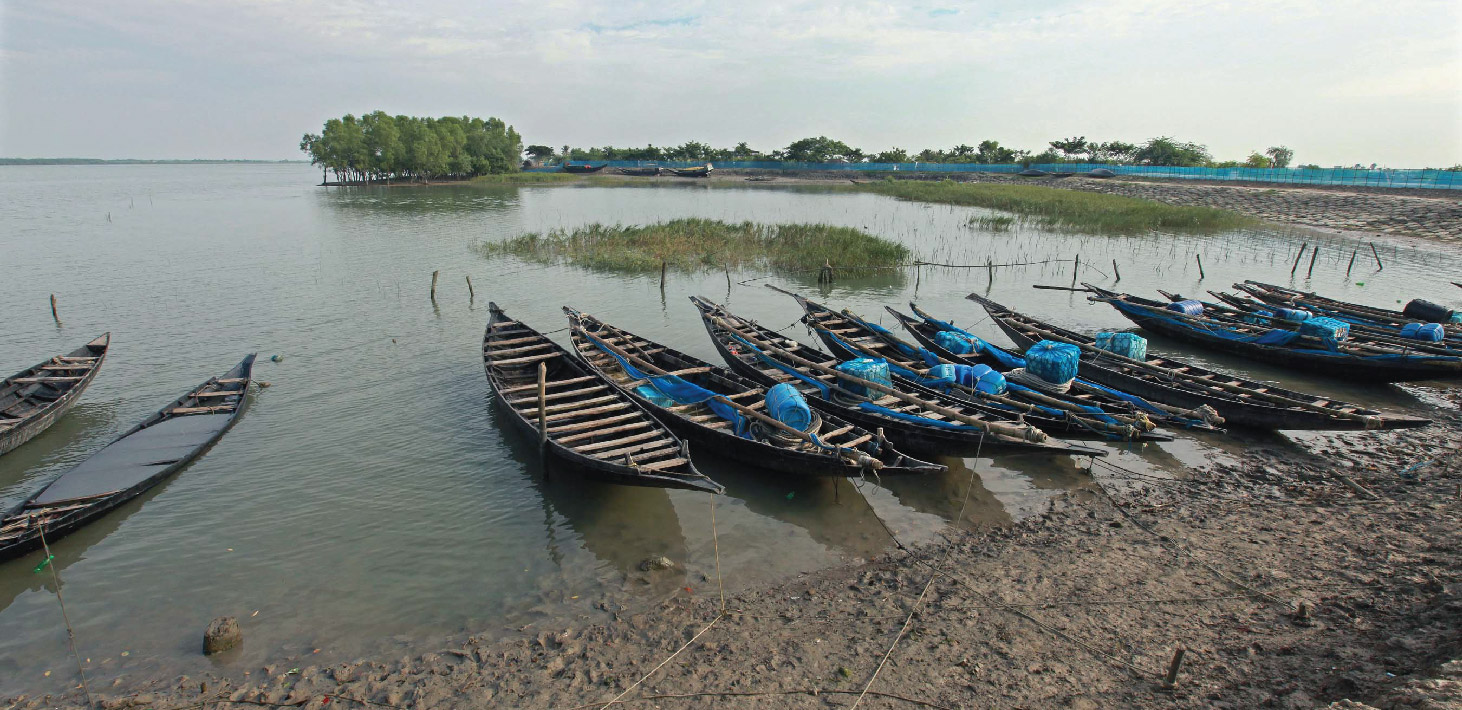
Post-Aila, people of this area are living their livelihood through working as day labourers migrating to Dhaka, Chittagong and Rajshahi district. Poor people can earn a good amount of money catching fishes, crabs and collecting honey from Sundarban. But they cannot save money and cannot help their family due to robbery at Sundarban area.
Ahammad Ali Gazi sighed as he surveyed his salt-covered land that once produced rice. ‘This is the land where my family grew rice for years,’ said Gazi, a 60-year-old farmer at Gabura in Satkhira district close to Bay of Bengal. ‘Today, there is nothing but salt. Nothing else grows here,’ murmured Gazi, wiping sweat from his sun-burnt face. The farmer has only himself to blame. Nearly three decades ago, Gazi, like many farmers in his area, quit rice farming to opt for shrimp cultivation that earned them more money. Money Gazi has earned. His earning from the business continued until cyclone Aila hit the southwestern part of the country on May 25, 2009.
The entire region was washed away. All the shrimp enclosures were gone. For about one and a half years, the area remained under saline water until the breaches Aila had created were repaired towards the end of last year. ‘We are not interested in shrimp cultivation anymore. We used to produce 12 to 15 maunds of rice per bigha before the business came. Now it has come down to less than 2 maunds,’ said Ganesh Chandra Mandal, a farmer of Bonloudub in Khulna. Unlike Gazi, Ganesh was compelled to get into shrimp cultivation in his little piece of arable land as rice production declined due to saline water in nearby shrimp beds.
Archana Rani, one of the Aila-hit habitants in Gabura, earned proper knowledge on crab fattening process from training provided by Shushilan, a partner of Oxfam under the REE-CALL project and after that she received necessary materials like bamboo cage, dram, bamboo sticks, crab, rope to start her own business. Now after one year, since she started her own business, Archawna is earning Tk. 1700 per month from the crabs. She is also using this money to utilize her sewing skills and thus adding a bit more to the monthly income for her family, which has now reached up to Tk. 4700.
Sundarban fights back
Life in the Sundarbans has undergone a sea change after Cyclone Aila swept through the area with some locals altering their farming methods and others rearing non-traditional livestock to cope with the difficult situation. Government agencies and NGOs have also trained people to prepare compost pits and get vermicompost as well as raise livestock in a difficult situation. Rearing goats and sheep is another way to earn a good living by small farmers and landless people.
Tourism Prospects
Thanks to an influx of NGOs working on rehabilitating the region, they are also bringing in more and more foreign workers and tourists, in an effort to economically bolster the region. This has enabled the people of Satkhira to look towards tourism prospects, selling honey and other Sundarban-related merchandises to the foreigners.
‘I felt devastated looking at the extreme poverty of this region,’ said Susan Howard, one of my friends who accompanied me to our trip to Satkhira. ‘But they seem so content and resilient, it is unbelievable.’ Talking to one of the vendors, he appreciated the brisk business, but lamented on the lack of local tourists. ‘People can go to Cox’s Bazar and Bandarban all they want, but Satkhira has a lot to offer,’ he said, ‘if we are given a chance to show what we have, the economy of this region will be able to bounce back before that of cyclone Aila.’