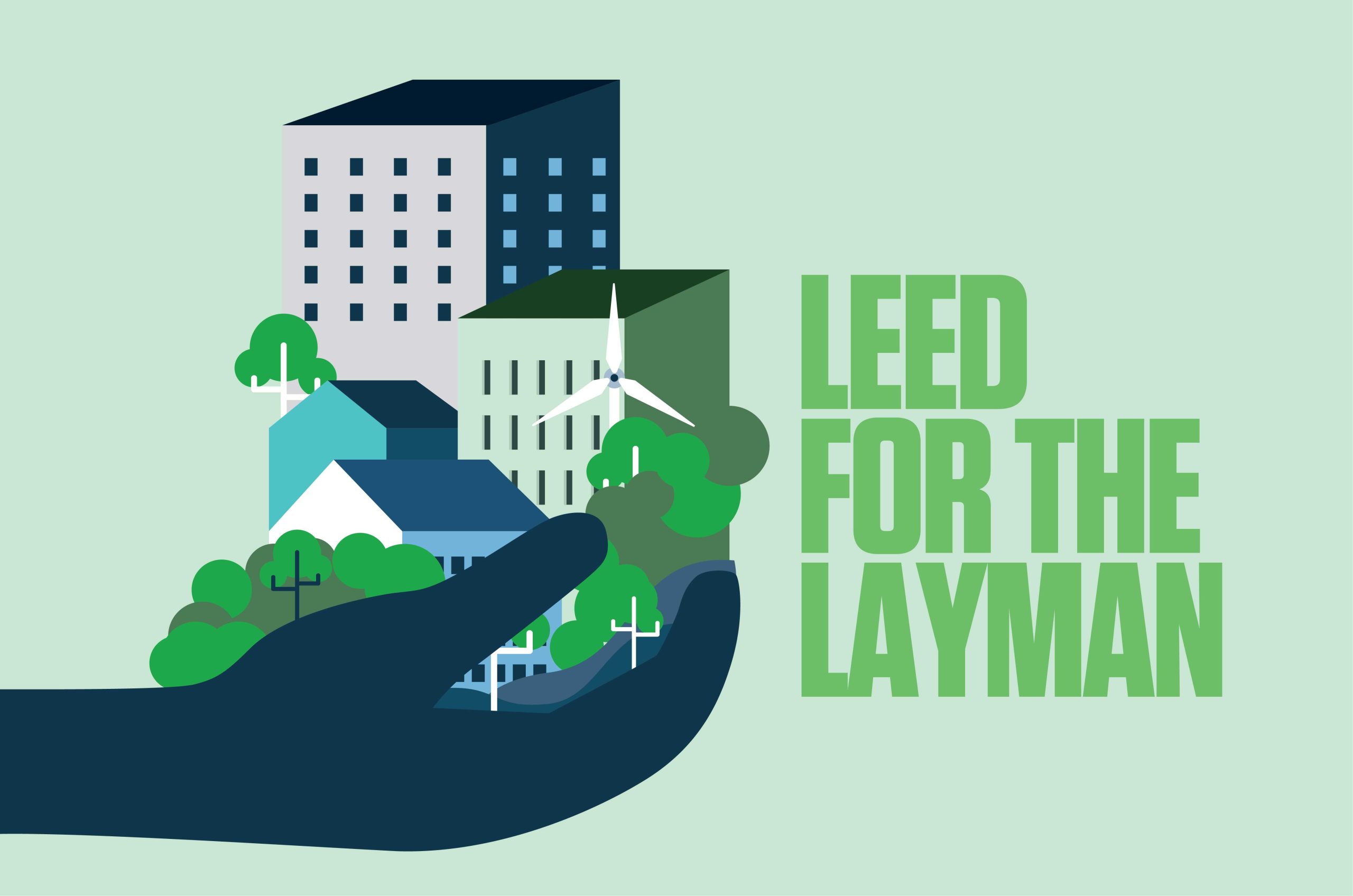

A comprehensive overview of LEED, the global standard for green and sustainable building practices.
The roots of sustainable building philosophies trace back to the early 1970s. Concerns for the environment grew between 1973 and 1980 when oil prices in the USA rose from USD 3.56 to USD 36 per barrel. It spurred significant research and activity to make energy renewable and more efficient. Combined with the environmental movement of the 1960s and 1970s, engineers, architects, and designers felt motivated to explore the concept of green, sustainable buildings to reduce energy usage and the long-term carbon footprint of permanent structures.
The first green building standard was released in 1990 in the United Kingdom. In 1992, the idea of sustainable development was heavily promoted at the United Nations Conference on Environment and Development, which inspired the adoption of the green building philosophy. But the pivotal moment for the growth of sustainable building practices occurred in 1993 with the establishment of the United States Green Building Council (USGBC). The USGBC devised the Leadership in Energy and Environmental Design (LEED) standards, which are still followed to this date. As of 2023, there are more than 100,000 LEED-certified projects around the world. This includes hospitals, homes, museums, schools, stadiums and manufacturing plants.
Consumers and the general public recognise that LEED-certified projects are better for the environment and promote good working conditions. However, knowledge of LEED criteria and the certification process is somewhat elusive. A better understanding is therefore needed to highlight the value proposition of LEED certifications.

What is LEED?
LEED is a third-party green building certification program. It is a globally recognised standard for the design, construction and operation of green buildings. The rating system approach focuses on efficiency and leadership to deliver the triple bottom line returns of ‘people, planet and profit.’
LEED is a holistic system that looks at the big picture, factoring in all critical elements that work together to create the best building possible. The goal of LEED is to create better buildings that reduce the impact of contributing factors of global climate change, protect and restore water resources, promote sustainable and regenerative material cycles, enhance individual human health, protect and enhance biodiversity and ecosystem services, and enhance community quality of life.
LEED Rating Systems
LEED has several rating systems depending on the type of project but all rating systems have prerequisites and credits. First and foremost, in order for a building to be put up for a LEED certification, it must meet certain green building criteria. These are broad prerequisites and if met, credits are awarded to determine what level of certification it receives. The prerequisite and credits vary slightly depending on the type of building, and the rating systems cover a wide range of sustainability aspects.
LEED is a third-party green building certification program. It is a globally recognised standard for the design, construction and operation of green buildings. The rating system approach focuses on efficiency and leadership to deliver the triple bottom line returns of ‘people, planet and profit.’
The different rating systems are LEED for Building and Construction (BD+C), LEED for Interior Design and Construction (ID+C), LEED for Building Operations and Maintenance (O+M), LEED for Neighborhood Development (ND) and LEED for Cities and Communities. Each rating system is organised on some broad concepts including, integrative process, location and transportation, sustainable sites, water, energy, materials and resources and indoor environment quality.
Under each rating system, there are different levels of certification. Certification is awarded based on a credits or points system. Points are based on multiple factors including location and planning, sustainable site development, water savings, energy efficiency, materials selection, waste reduction, indoor environmental quality, innovative strategies and attention to priority regional issues. The credits are weighted based on current sustainability concerns that need immediate action. Therefore, 35% of LEED credits are related to climate change, 20% directly impact human health, 15% impact water resources, 10% affect biodiversity, 10% relate to the green economy, and 5% impact community and natural resources.
Concretely, the prerequisites for LEED certification need to fulfil the USGBC’s minimum program requirements (MPR). There are 3 MPRs; the project must be in a permanent location on existing land, it must use reasonable LEED boundaries, and it must comply with project size requirements. For example, under BD+C and O+M rating systems, the project must have at least 1000 square feet of gross floor area. For ID+C, the project must have a minimum of 250 square feet of gross floor area. The LEED project boundary must take into account all contiguous land that is associated with the project. This includes land altered as a result of construction and features used primarily by the project’s occupants such as parking and sidewalks, septic or stormwater treatment equipment, and landscaping.
If a project meets the MPRs, it can earn points under 9 metrics. A building can score a maximum of 33 points under energy and atmosphere, 16 for location and transportation, 16 for indoor environment quality, 13 under materials and resources, 11 for water efficiency, 10 under sustainable sites, 6 for innovation, 4 for regional priority, and 1 for the integrative process.
35% of LEED credits are related to climate change, 20% directly impact human health, 15% impact water resources, 10% affect biodiversity, 10% relate to the green economy, and 5% impact community and natural resources.
A building can score a maximum of 110 points. Based on the prerequisite fulfilment and points awarded, a building can earn one of four LEED certifications. Between 40 to 49 points, a building is certified LEED. Silver LEED certification is awarded for 50 to 59 points, Gold for 60 to 79 points, and Platinum if more than 80 points are earned.
Benefits of LEED
LEED-certified buildings increase real estate value making them a solid asset for investors, occupiers and communities. Investors can follow LEED guidelines to implement management practices that build efficiency and decrease operational costs. Effectively, it contributes directly to meeting an organisation’s environmental, sustainability and governance (ESG) goals. According to a 2021 study, LEED-certified buildings command 11.1% higher rent in the U.S., increase occupancy rates by up to 2%, and generate 77.5% more price per square foot compared to non-certified buildings.
In a study conducted by the USGBC, it was found that employers in LEED-certified spaces report higher recruitment and retention rates. The spaces also increase employee productivity, improve indoor air quality, lower pollution, and improve outdoor air quality in major industrialised areas.
Energy usage and carbon emissions are significantly decreased when LEED projects adhere to specified guidelines. A 2011 study reported that LEED-certified buildings have 34% lower CO2 emissions, consume 25% less energy, use 11% less water, save more than 1.3 million tons of coal equivalent each year, and divert 80 million tons of waste from landfills.
LEED-certified buildings increase real estate value making them a solid asset for investors, occupiers and communities. Investors can follow LEED guidelines to implement management practices that build efficiency and decrease operational costs.
LEED Criticism and Evolution
The USGBC acknowledged very early on that LEED certifications would have to be an evolving process to keep itself updated as new challenges presented themselves. Throughout the years, researchers have highlighted some shortcomings of LEED assessment processes. In 2005, Auden Schendler, a LEED-accredited professional criticised the LEED certification process as being “costly, slow, brutal, confusing and unwieldy.” Writer David Owen brought forward the hidden costs of green projects, particularly the unaccounted cost of transportation and consequent fossil fuel burning due to travelling to and from green buildings located far away from residential areas. An analysis by USA Today found the minimum criteria to meet LEED certification was not thorough enough and was easily attainable without necessarily being green or sustainable. They concluded that LEED-certified buildings in New York City performed only as well as non-certified buildings as the state-mandated building standards already matched the minimum requirements to acquire a LEED certification. The USGBC actively addresses major criticisms by updating LEED versions.
The pilot version was the LEED New Construction (NC) v1.0. It was soon followed by LEED NCv2.0, and then LEED NCV2.2 in 2005. LEED v3 was released in 2009, and LEED v4 in 2013. The latest certification is LEED v4.1 which was released on 2 April 2019. Each new version addresses the major concerns and shortcomings of previous versions, ensuring that LEED certification continues to offer a high-value proposition. Subsequently, the USGBC’s standards for LEED have evolved over time to also accurately represent and incorporate emerging green building strategies and technologies.
LEED in Bangladesh
As of 3 April 2023, according to the Green Building Information Gateway (GBIG), the USGBC’s premier search engine for green building insights, there are 186 LEED-certified projects in Bangladesh. Of these projects, 4 are certified LEED, 15 are Silver, 109 are Gold, and 58 are Platinum. The garment industry in Bangladesh is proactive in greening its manufacturing plants and reducing its carbon footprint. Recently, a Bangladeshi readymade garment factory achieved the highest LEED score in the world under the industry category. Additionally, among the top 10 LEED-certified factory units in the world, 9 are from Bangladesh. Among the top 100, 52 are in Bangladesh. The Bangladesh Garments Manufacturers and Exporters Association (BGMEA) has reported that more than 500 more factories are in the pipeline for LEED certification.

The Future of LEED
The USGBC is currently working on the next version of LEED to be directly in line with the United Nations Sustainable Development Goals (UNSDG). The direction forward will happen in phases to gradually align its targets with the ones outlined in the Paris Agreement. The focus will be to design scoring systems that address critical imperatives including equity, health, biodiversity and resilience. The guiding principles will be centred around climate change, starting with increasing the scale of operations for the greatest impact, decarbonising the building industry swiftly to reflect the urgency of the climate crisis, inspiring adaptive and resilient built environments, investing in human health and well-being, creating environments in which diversity, equity and inclusivity thrive, and supporting ecosystems through regenerative development practices.