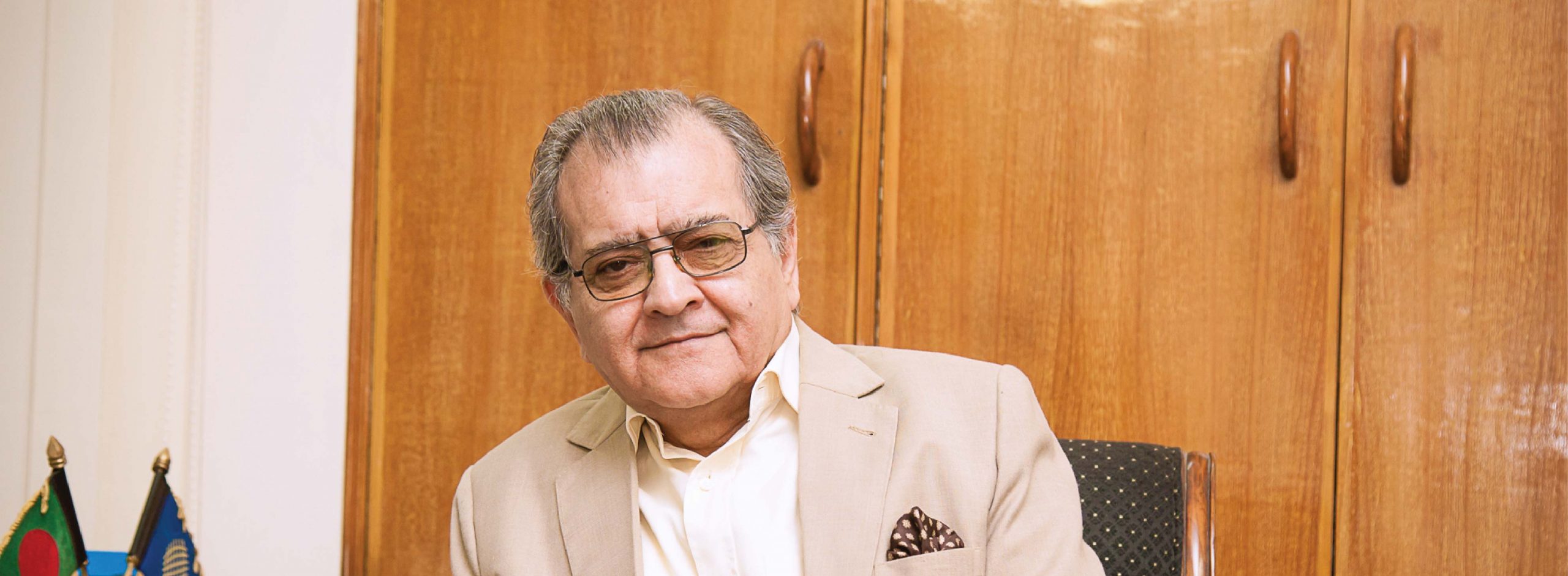

Ambassador Farooq Sobhan, during his long diplomatic career, has held various posts in the Foreign Services beginning in 1964. He has extensive experience, working on the international platform, having been posted in Cairo, Paris, Belgrade and Moscow in the past. In early 1972, he returned to Bangladesh to join the newly established Ministry of Foreign Affairs. From 1981-84 he was the Deputy Permanent Representative of Bangladesh to the United Nations in New York which was followed by ambassadorships in Malaysia and China. He served for three years as the High Commissioner to India and then the Foreign Secretary from 1995 to 1997 after which he concluded his illustrious career.
Since 2000 he has been serving as the President of the Bangladesh Enterprise Institute (BEI), an independent non-profit research organization focusing on private sector development in Bangladesh. He is also the Chairman, Board of Trustees of the CSR Center.
What is the status of Corporate Social Responsibility (CSR) in Bangladesh?
CSR has been recognized by most stakeholders in Bangladesh, especially the private sector, as an upcoming phenomenon for responsible behavior by corporations and the relevant stakeholders to uptake global standards and performance. With the adoption of the Sustainable Development Goals SDG, CSR is gaining momentum nationally. Its linkage with sustainable development initiatives has given some of the larger companies’ scope for responsible actions through better performance in terms of labor standards and human rights, etc.
As your organization actively evaluates CSR practices, what are the contextual and conceptual sides of CSR in Bangladesh?
CSR can be both internal and external. In Bangladesh, external CSR is common but rarely links to the business strategy of an organization. By understanding these two dimensions of CSR which both link to the internal environment of an entity such as workforce, labor standards, and human resource policies etc, good CSR practices can be evaluated. Unless the concept and understanding of CSR are clear it will be difficult to evaluate.
Farooq Sobhan, CEO and President
Bangladesh Enterprise Institute
“There has to be a holistic approach and human rights is central to this. Today the outstanding examples in my view would be the Nordic countries like Denmark, Sweden, Norway, Finland, etc.”
How do you define CSR in the context of Bangladesh?
CSR is not different as per country context but we can have different markers to measure it. For instance, in Bangladesh, we lack maintaining minimum standards or local regulatory frameworks. We need to work for this, although CSR goes beyond compliance. Companies that are already adhering to national compliance can do CSR effectively and that is already a work in progress.
How can the status of CSR be improved in Bangladesh? How does sustainable development play a part in this?
CSR and sustainable development, in many ways today, have become coterminous. The two are inextricably linked. We have been taking an interest in promoting CSR for the last 16 years since we established BEI. Eight years after the BEI’s inception, we established the CSR Center. Over this time, awareness, acceptance, and recognition of the importance of CSR both in the public and private sectors have improved significantly. We have seen all that the government is supporting the idea of CSR along with the Bangladesh Bank and the Finance Ministry. What we think will further help in promoting CSR is if we are aligned ourselves with practices followed in other parts of the world. Providing tax incentives to private institutions might further help in promoting CSR.
Another important issue is promoting a better understanding of what CSR is as a lot of people tend to confuse it with philanthropy or charitable contributions. What also needs to be understood is that it is not only for the private sector. When we speak of social responsibility, it applies to the government as well. I would like to mention, in particular, government ministries and government entities like the state-owned banks such as - Sonali, Janata, and Rupali. It is not only a case of what the private sector must do to protect and support the environment, the community, and its employees; it is equally important what government and its agencies do in this area. For example, I would be a strong advocate of deploying the armed forces in a major annual tree planting exercise. My last point in this regard is to speak of certain practices and standards. In the RMG sector, there are companies practicing a higher standard of CSR. However, there are also companies who think they are practicing it but their standards are below par. Therefore, we need to also see how we can measure and benchmark the CSR that is being practiced across the country. This awareness and understanding are of key importance and that is one of the things we are trying to do through the CSR Center.
As human rights are also a part of CSR, how can it be implemented in the organizational set up of different organizations in Bangladesh?
One of the ten principles of UNGC includes human rights. The CSR Center has already done a lot of work on this issue by introducing the agenda of business and human rights, developing a handbook on this topic, conducting a ToT on human rights and introduced the UN Guiding Principles (UNGPs) into the RMG sector in Bangladesh. Also, it has done training sessions for managers and executives from various sectors.
What must be recognized as the fundamentals for human rights? Could you use one country as an example?
In the context of CSR, how you treat your employees is of critical importance. Within this, it is imperative that we also address the issue of inequality. In the past, we’ve addressed the problem of eliminating poverty. Today, in addition to that, we must also think in terms of addressing the problem of income inequality in Bangladesh and its neighboring nations. The gap between the well-to-do and the less well-to-do must narrow significantly and I think that should be another aspiration in terms of promoting good corporate social responsibility
Alongside human rights, it is equally important how you look after the community in which you are functioning. You may be practicing the best CSR standard for your workers but if your factories are polluting the environment, you cannot claim to be promoting sustainable development. There has to be a holistic approach and human rights is central to this. Today the outstanding examples in my view would be the Nordic countries like Denmark, Sweden, Norway, Finland, etc. They practice a very high standard of CSR and sustainable development. They have also been able to substantially reduce the gap between different segments of their society.
What is the part of Occupational Health and Safety (OHS) in Bangladesh?
The CSR Center has been conducting over 100 training sessions on OHS issues in Bangladesh. Through BSCI, they have produced localized training manuals on occupational health and safety for the RMG sector. As this is a critical issue in all sectors of Bangladesh, the CSR Center proposes that such training sessions must be conducted in other sectors such as food and agriculture, pharmaceuticals, leather, construction, etc.