
How Lee Kuan Yew shaped today’s Singapore and its economy
One of the world’s great economic success stories, Singapore owes much of its prosperity to a record of honest and pragmatic government, the legacy of Lee Kuan Yew, who has died aged 91. He retired as prime minister in 1990 but his influence shaped government policy until his death, and will continue to do so beyond.
Born when Singapore was a British colony, the young Lee saw the humiliation of the colonial power by Japan and the tough years of Japanese occupation. A brilliant scholar, he thrived in London and Cambridge after the war and came back to Singapore to assume a leading role in the anti-colonial struggle, co-founding the People’s Action Party (PAP), which governs Singapore to this day. Lee was its leader, and Singapore’s prime minister, when it won self-government from Britain in 1959. He led Singapore into merger with Malaysia in 1963 and, after their divorce in 1965, as a small, fragile independent nation. Singapore’s prosperity and orderliness won admirers East and West, and came to be viewed as a kind of model.
Lee’s political views, however, were controversial. Decrying the decadence and welfarism which he thought had sapped the strength of countries such as Britain, he supported tough laws and punishments, making Singapore orderly, clean and disciplined. He was quick to use British-era legislation, including a draconian Internal Security Act, to quell anything that smacked of subversion. Defamation suits were used to tame the press and, on occasion, bankrupt his critics. The current prime minister is his son, Lee Hsien Loong, ensuring continuity of a sort. The elder Lee left the cabinet in 2011, after the PAP’s worst-ever general-election performance. It still won 60% of the vote, but there was growing resentment at the high levels of immigration—a consequence of Singaporean women’s very low fertility rates. After the election, although he retained his seat in parliament, Lee looked visibly frail. Yet he was so towering a figure in Singapore’s half-century history that many of its people will find his passing an unnerving moment.
Not just political
Economic policies are always made within a framework which either explicitly or implicitly incorporates some guiding philosophical principles. It was Lee who provided that basic framework and it was fortunate for Singapore that his instincts were in the right direction. This was evident in a range of issues which eventually came to be hallmarks of the Singapore development experience.
He realised, for instance, that any business environment had to be supportive of large companies as well as small ones, foreign investors as well as domestic ones, and workers as well as businessmen. He took the lead in breaking away from the dirigiste, state-planning policies of his developing country peers in the 1960s to embrace outward-looking policies that enabled the Singapore economic takeoff. At a time when it was not the intellectual fashion to do so, he accepted that allowing businesses to make good profits would be good for the average man.
His instincts were also in the right place when he decided that Singapore should abjure the state-funded welfare policies that many other developing countries had embraced after their independence, insisting instead on creating the culture of self-reliance that has served Singapore so well.
By strengthening the Corrupt Practices Investigation Bureau and placing it under his direct charge, Singapore was able to robustly tackle corruption, creating one of the least corrupt business environments in the world – something that clearly contributes to Singapore’s super-competitive economic position.
Singapore is small and highly vulnerable. Yet, it is also remarkably resilient – because it has developed an impressive capacity to bounce back from the shocks or crises that have a habit of erupting every now and then. The reason is that we have learnt from Lee’s forceful response each time Singapore faced a severe test. Whether it was the sudden separation from Malaysia in 1965, the equally stunning announcement of the withdrawal of British forces from Singapore in 1968, the two oil shocks of the 1970s or the recession in the mid-1980s, Lee showed the way by mobilising the full resources of the government to find a solution and push its implementation through. This allowed the economy to rebound from each shock, each time emerging even stronger.
While Lee was averse to the welfare state, he knew he had to ensure that the fruits of growth were fairly distributed. This was evident, for example, in his determination to ensure that every citizen had a stake in the country. The home-owning society that Singapore is today came out of this insight. This philosophy spun off many initiatives which are now defining features of the Singapore economy such as the extremely high home ownership rate, the use of Central Provident Fund savings to finance mortgages and the constant upgrading of public housing estates to enhance their value.
If there was one contribution that stood out the most, it would be how he kept pushing Singapore to re-invent its economy every now and then. He had the foresight to anticipate economic challenges and opportunities well ahead of time while also coming out with strategies to respond effectively to the same.
He was well ahead of the game in environmental protection when he pushed for Singapore as a Garden City. He foresaw the problems with road congestion and pushed for pro-active policies such as the Area Licensing Scheme which was the precursor to the current Electronic Road Pricing scheme: that made Singapore a world leader in using a market tool – pricing road congestion – to control traffic. He was also early in visualising the combination of telecommunications and computers and so pushed for Singapore to move rapidly in computerisation in the 1980s. He used the same uncanny long-range vision he had to raise the issue of ageing and declining fertility in the 1980s when few pundits were talking about it.
One of his signal achievements was the push for financial liberalisation in the late 1990s which led to a surge of growth and created the global financial centre of today.
He was also prescient in encouraging the growth of the Singapore economy’s second wing in the late 1980s, when he realised that as the economy matured, it would need to look beyond the confines of its territorial limits to find growth opportunities. In particular, he played a decisive role in encouraging Singaporean companies to invest in China. His personal involvement in leading delegations to China and in conceiving projects for Singaporeans to transfer knowledge to China helped Singapore establish a foothold in China well beyond what its small size implied.
In short, one of Singapore’s great economic strengths is the ability to constantly reinvent itself – Lee was instrumental in inculcating this ability and leading change when needed. Importantly, he combined this capacity for great vision with an unrelenting emphasis on focusing on the long term, so that the benefits of anticipating big changes were not sidetracked by the short-term pain that was sometimes necessary to achieve the bold vision.
Many have remarked how there is a certain ‘Singapore brand’ which helps its economy in many ways. The Singapore economy is seen as standing for certain qualities in a way few other countries are. Abroad, Singapore is seen as tough-minded, effective, honest and straight shooting, all values that Lee inculcated in Singapore. He was Singapore’s main marketeer, our main ‘brand ambassador’ – his persona and ideas moulded the ‘Singapore’ brand which brought in the foreign investment which transformed Singapore.
On the whole, however, few would question that Mr Lee’s overall contribution to economic development was immense and positive. The mark of truly historic personalities is not in their being able to avoid errors but in how they ensured that the mistakes were small while the achievements were grand. So it is with Lee Kuan Yew.
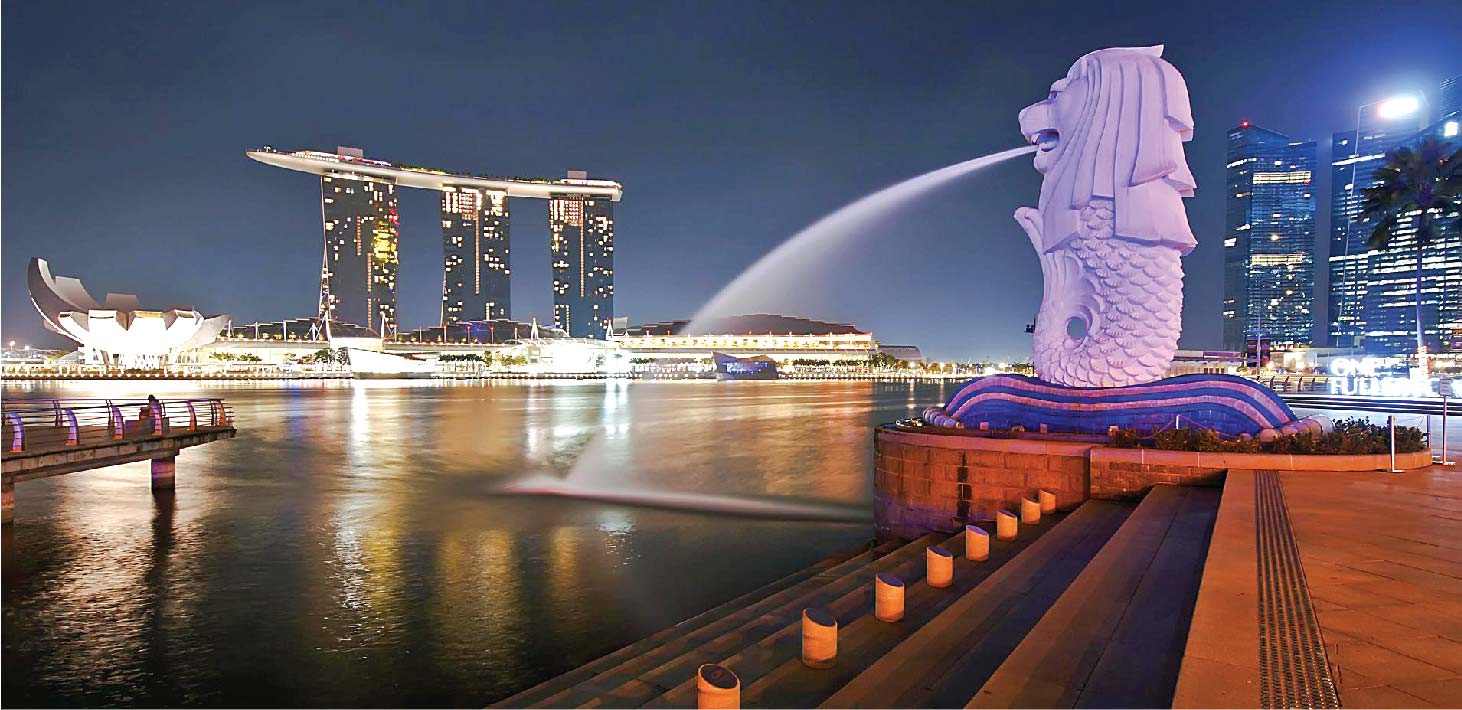
When the great British architect Christopher Wren was interred in St Paul’s Cathedral in 1723, the epithet read: ‘Reader, if you seek his monument, look around you.’ One could say the same for Lee Kuan Yew: if you seek his monument, look around Singapore. As much in its political system as in the economy, no one has left such a strong and indelible imprint of himself in a country as Lee has. And Singapore is so much the better for that.