


Page 88 - ICE BUSINESS TIMES February 2020
P. 88
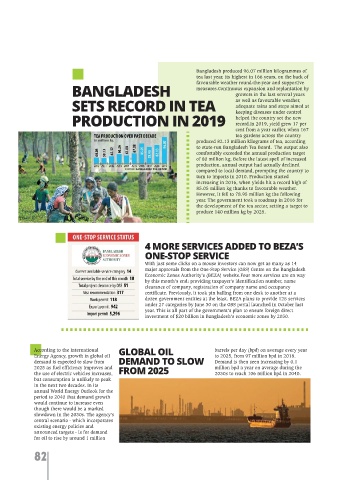
Bangladesh produced 96.07 million kilogrammes of
                                                                        tea last year, its highest in 166 years, on the back of
                                                                        favourable weather round-the-year and supportive
                           BANGLADESH                                   measures.Continuous expansion and replantation by
                                                                                      growers in the last several years
                           SETS RECORD IN TEA                                         as well as favourable weather,
                                                                                      adequate rains and steps aimed at
                           PRODUCTION IN 2019                                         keeping diseases under control
                                                                                      helped the country set the new
                                                                                      record.In 2019, yield grew 17 per
                                                                                      cent from a year earlier, when 167
                                                                                      tea gardens across the country
                                                                        produced 82.13 million kilograms of tea, according
                                                                        to state-run Bangladesh Tea Board.  The output also
                                                                        comfortably exceeded the annual production target
                                                                        of 80 million kg. Before the latest spell of increased
                                                                        production, annual output had actually declined
                                                                        compared to local demand, prompting the country to
                                                                        turn to imports in 2010. Production started
                                                                        increasing in 2016, when yields hit a record high of
                                                                        85.05 million kg thanks to favourable weather.
                                                                        However, it fell to 78.95 million kg the following
                                                                        year. The government took a roadmap in 2016 for
                                                                        the development of the tea sector, setting a target to
                                                                        produce 140 million kg by 2025.


                                                     4 MORE SERVICES ADDED TO BEZA’S
                                                     ONE-STOP SERVICE

                                                     With just some clicks on a mouse investors can now get as many as 14
                                                     major approvals from the One-Stop Service (OSS) Centre on the Bangladesh
                                                     Economic Zones Authority’s (BEZA) website.Four more services are on way
                                                     by this month’s end: providing taxpayer’s identification number, name
                                                     clearance of company, registration of company name and occupancy
                                                     certificate. Previously, it took pin balling from one desk to another at a
                                                     dozen government entities at the least. BEZA plans to provide 125 services
                                                     under 27 categories by June 30 on the OSS portal launched in October last
                                                     year. This is all part of the government’s plan to ensure foreign direct
                                                     investment of $20 billion in Bangladesh’s economic zones by 2030.


             According to the International   GLOBAL OIL                      barrels per day (bpd) on average every year
             Energy Agency, growth in global oil                              to 2025, from 97 million bpd in 2018.
             demand is expected to slow from   DEMAND TO SLOW                 Demand is then seen increasing by 0.1
             the use of electric vehicles increases,  FROM 2025               million bpd a year on average during the
             2025 as fuel efficiency improves and
                                                                              2030s to reach 106 million bpd in 2040.
             but consumption is unlikely to peak
             in the next two decades. In its
             annual World Energy Outlook for the
             period to 2040 that demand growth
             would continue to increase even
             though there would be a marked
             slowdown in the 2030s. The agency’s
             central scenario - which incorporates
             existing energy policies and
             announced targets - is for demand
             for oil to rise by around 1 million

             82

