


Page 80 - ICE BUSINESS TIMES March 2020
P. 80
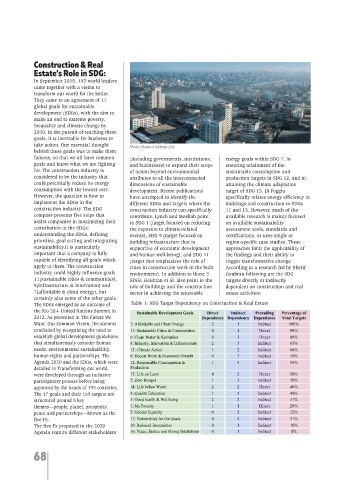
Construction & Real In the 17 SDGs there are 169 targets.
Estate’s Role in SDG: 74 of the 169 targets of the agenda
(44%) were found to be dependent on
In September 2015, 193 world leaders construction and real estate
came together with a vision to activities—of which 29 targets (17%)
transform our world for the better. are directly dependent and 45 targets
They came to an agreement of 17 (27%) indirectly dependent.
global goals for sustainable Le Blanc presents a linkage map for
development (SDGs), with the aim to all the SDG targets where the targets
make an end to extreme poverty, are connected based on their
inequality and climate change by synergies or similarity, and concluded
2030. In the pursuit of reaching these that the targets of SDG 11, which is
goals, it is inevitable for business to generally cited as the most relevant to
take action. One essential thought !"#$#%&'"()$(&*#+,-)./&0$,1 construction and real estate, are
behind these goals was to make them connected to SDG 3 through 5 targets,
famous, so that we all have common (including governments, institutions, energy goals within SDG 7, in SDG 1 through 4 targets, SDG 12 and
goals and know what we are fighting and businesses) to expand their scope ensuring attainment of the SDG 10 through 3 targets each, SDG 6
for. The construction industry is of action beyond environmental sustainable consumption and through 2 targets, and SDG 16
considered to be the industry that attributes to all the interconnected production targets in SDG 12, and in through only 1 target. The analysis
could potentially reduce its energy dimensions of sustainable attaining the climate adaptation conducted in this research revealed
consumption with the lowest cost. development. Recent publications target of SDG 13. Di Foggia that the two SDGs (namely SDG 1 and
However, the question is how to have attempted to identify the specifically relates energy efficiency in SDG 3) (which Le Blanc found to be
implement the SDGs in the different SDGs and targets where the buildings and construction to SDGs most connected to SDG 11) are not
construction industry. The SDG construction industry can specifically 11 and 13. However, much of the the most highly dependent on current, potential, positive and value chain of the product, process or
compass presents five steps that contribute. Lynch and Mosbah point available research is mainly focused construction and real estate negative impacts they have on the service, and calculates the
assist companies in maximizing their to SDG 1 (target focused on reducing on available sustainability activities: SDG 1 has only 1 target SDGs and the likelihood of future corresponding emissions to the
contribution to the SDGs: the exposure to climate-related assessment tools, standards and (14% of the goal’s targets) directly ones. A way for the companies to do environment. LCA thus assesses
understanding the SDGs, defining events), SDG 9 (target focused on certifications, or uses single or dependent on construction and real this assessment is by executing a cumulative potential environmental
priorities, goal setting and integrating building infrastructure that is region-specific case studies. These estate activities, and SDG 3 has 2 high-level mapping of their value impacts. The aim is to document and
sustainability.It is particularly supportive of economic development approaches limit the applicability of targets directly (15% of the goal’s chain, where areas with high improve the overall environmental
important that a company is fully and human well-being), and SDG 11 the findings and their ability to targets) and 2 indirectly (15% of the likelihood of either negative or profile of the product.
capable of identifying all goals which (target that emphasizes the role of trigger transformative change. goal’s targets) dependent on positive impacts on the issues that
apply to them. The construction cities in construction work in the built According to a research led by Sherif construction and real estate activities. the SDGs represent are identified. Environmentally-extended
industry could highly influence goals environment). In addition to those 3 Goubran following are the SDG input-output (EEIO) models:
11(sustainable cities & communities), SDGs, Goubran et al. also point to the targets directly or indirectly Steps for Future: Tools: Environmentally-extended
9(Infrastructure & Innovation) and role of buildings and the construction dependent on construction and real To map high impact areas, certain input-output (EEIO) models are
7(affordable & clean energy), but sector in achieving the renewable estate activities: The construction industries need to tools and methodologies are consumption-based indicators of
certainly also some of the other goals. take initiatives to implement the available: material use are commonly referred to
The SDGs emerged as an outcome of Table 1: SDG Target Dependency on Construction & Real Estate SDGs in their business platforms. as “material footprints” (comparable
the Rio 20+ United Nations Summit in Sustainable Development Goals Direct Indirect Prevailing Percentage of There are five distinct steps: Life Cycle Assessment (LCA) to carbon footprints and water
2012. As presented in The Future We Dependency Dependency Dependence Total Targets l understanding the SDGs, methodologies: footprints) or as raw material
Want. Our Common Vision, the summit 7: Affordable and Clean Energy 2 1 Indirect 100% l defining priorities, Life-cycle assessment or life cycle equivalents (RME) for imported and
concluded by recognizing the need to 11: Sustainable Cities & Communities 4 1 Direct 90% l setting goals, assessment (LCA, also known as exported goods. Raw material
establish global development guidelines 6: Clean Water & Sanitation 8 3 Direct 88% l integrating, and life-cycle analysis) is a methodology equivalents or material footprints of
that simultaneously consider human 9: Industry, Innovation & Infrastructure 2 3 Indirect 63% l reporting and communicating. for assessing environmental impacts traded goods comprise the material
needs, environmental sustainability, 13: Climate Action 1 2 Indirect 60% The goals should be set with associated with all the stages of the inputs required along the entire
human rights and partnerships. The 8: Decent Work & Economic Growth 0 7 Indirect 58% time-bound targets. The goals should life-cycle of a commercial product, supply chain associated with their
Agenda 2030 and the SDGs, which were 12: Responsible Consumption & 1 5 Indirect 55% be monitored, evaluated, reported and process, or service. For instance, in production. This includes both direct
detailed in Transforming our world, Production communicated among the the case of a manufactured product, and indirect flows: For example, the
were developed through an inclusive 15: Life on Land 4 2 Direct 50% stakeholders. The industries are to be environmental impacts are assessed ore mined to extract the metal
participatory process before being 2: Zero Hunger 1 3 Indirect 50% prepared accordingly, just as from raw material extraction and contained in a mobile phone as well
approved by the heads of 193 countries. 14: Life below Water 2 2 Direct 40% universities are prepared for processing (cradle), through the as the coal needed to generate the
The 17 goals and their 169 targets are 4: Quality Education 1 3 Indirect 40% accreditation of their programmes. product's manufacture, distribution electricity needed to produce the
structured around 5 key 3: Good health & Wellbeing 2 2 Indirect 31% The 17 SDGs represent targets and and use, to the recycling or final metal concentrates would be
themes—people, planet, prosperity, 1: No Poverty 1 1 DIrect 29% goals which aim towards a somehow disposal of the materials composing it included. In order to allocate domestic
peace and partnerships—known as the 5: Gender Equality 0 2 Indirect 22% perfect world, but not all of them are (grave). extraction to exported goods,
five Ps. 17: Partnerships for the Goals 0 4 Indirect 21% equally relevant for each individual An LCA study involves a thorough information on the production and
The five Ps proposed in the 2030 10: Reduced Inequalities 0 1 Indirect 10% company. Each individual company inventory of the energy and materials trade structure of an economy is
Agenda require different stakeholders 16: Peace, Justice and Strong Institutions 0 1 Indirect 8% should conduct an assessment on the that are required across the industry required. In monetary terms,
68

