


Page 89 - IBT December 2020
P. 89
Bangladesh had
                                               already started its
                                               migration towards
                                               online education with

             are not only required to receive top   a growing number of
             grades in classes but to also garner   SaaS facilitated
             experience from side projects,                                        for supporting new learning
             extra-curricular activities and   education startups in               approaches. It is ascertainable that
             demonstrate deftness in a host of                                     even though EduTech industry in
             thinking and communication skills.   Dhaka, however with              Bangladesh is still in its nascent
             These skills are required not just for   the COVID-19                 stage it has tremendous potential in
             acceptance at international                                           driving social impact and also in
 Dhaka, however with the COVID-19   and maturity of WAVE (Whiteboard,   workplaces and higher educational   pandemic the move   creating profitable business
 pandemic the move has been made   Audio, Video Environment)   institutes but are also examined   has been made more   opportunities for new investors.
 more imminent.  technologies in Bangladesh in recent   when applying to jobs nationally.    About 2 percent of our GDP goes to
 years, online systems can well   EduTech can supply the framework   imminent.     education-related spending, which
 OUTLOOK AND   accommodate regular lectures and                                    means that the market value of
 Educational Technology or EduTech   more students from varying                    education in our country based on
 has not only revamped the way   CAPACITY  demographics can hone these skills      the education ministry budget is
 classrooms operate but has also   Some people may wonder whether   effectively in the future.   Top 10 skills  over USD 6 billion.
 created a new arena for it, digital   students in Bangladesh will be able         Now is also the time to bridge the
 classrooms. The traditional method   to adjust to online learning and   FUTURE    established industry-academia gap
 of “talk and chalk” is in the advent   learn sufficiently. The fact of the   While digitization is enhancing   in 2020  in 2015  with the integration of
 of being replaced by International   matter is today’s students are   productivity in businesses and   industry-relevant, digital skills in
 platforms providing MOOCs and/or   already learning from content on   industries, automation has begun   1.   Complex Problem Solving  1.   Complex Problem Solving  the typical education system. The
 simulation-based classroom tools.   sites such as Youtube, Udemy,   snapping its jaws at the workforce   2.   Critical Thinking  2.   Coordinating with Others  potential of bridge education in the
 Bangladesh had already started its   Coursera, edX, and others. With the   with threats of replacement. This is   3. Creativity  3.  People Management  present context is to equip students
 migration towards online education   improvement of internet   causing an increased expectation of   4.  People Management  4.  Critical Thinking  with the right skills to make them
                                                 5. Negotiation
                  5.  Coordinating with Others
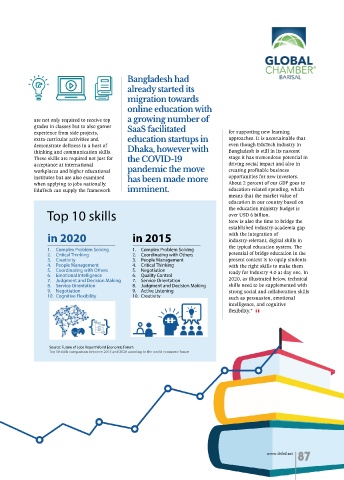
 with a growing number of SaaS   connectivity, data rates, the   the workforce to have novel and   6.  Emotional Intelligence  6.  Quality Control  ready for Industry 4.0 at day one. In
 facilitated education startups in   advancement of software technology,   7.  Judgment and Decision Making  7.  Service Orientation  2020, as illustrated below, technical
 diverse sets of skills. Students today
                  8.  Service Orientation        8.  Judgment and Decision Making  skills need to be supplemented with
                  9. Negotiation                 9.  Active Listening              strong social and collaboration skills
                  10.  Cognitive Flexibility     10. Creativity                    such as persuasion, emotional
                                                                                   intelligence, and cognitive
                                                                                   flexibility.”


                   Source: Future of Jobs Report World Economic Forum
                   Top 10 skills comparison between 2015 and 2020 acording to the world economic forum


                                                                                                            87
                                                                                                 www.ibtbd.net

