Problems and Prospects
ities have always been the center of growth for a civilization. In earlier times, rivers were the lifelines for the cities, in ancient civilizations. But along with history, surface transports like roads and rails started to get preferences because of being reliable, fast and user-friendly (especially some of them provide door-to-door services). For the first time in history, the Romans constructed a large transport network and infrastructures like bridge and dykes and gave birth to the phrase All roads lead to Rome. Also, the Silk Route and the Royal Route existed for thousands of years. But all of these trade links which connected regions, not urban corridors.
The cities had avenues and plazas, which were designed basically for the pedestrians and used as a gathering space, generally as a market. Even though Dhaka was quite small in terms of area, it also had a Chawk (city center), like most of the famous cities around the world at that time. As more and more new cities came into being and existing ones were rapidly expanding in the middle ages, the idea of public transport came up, a mode of transport which can be shared.
Where Does Dhaka Lie?
Even though Bangladesh has achieved an amazing feat in reducing the annual growth rate of population, the size of the population is still large when compared with the size of the country. If the current trend continues, the population of Bangladesh is expected to reach to about 194 million in 2050 (UN 2012). Understandably, this population exerts tremendous pressure on a limited resource base.
Along with national population growth, the percentage of people living in urban areas has also been rising. 1.8 million people were living in urban areas in 1951 which increased to 13.5 million, 22.5 million, 31 million and 33.5 million in 1981, 1991, 2001 and 2011 respectively; an eighteen-fold increase in last 60 years. The country faces enormous challenges in coping with the infrastructures and service requirements for its rapidly growing urban population, particularly in the capital city – Dhaka.
Dhaka has seen astonishing growth and rapid development since 1971. It has changed into the capital of a nation from a mere provincial city since the birth of Bangladesh. It is one of the only seven cities in the world which has experienced urban population growth higher than 2.4% between 1975-2005 (UN, 2006). It was one of the top ten megacities in the world in 2011 in terms of population. Unfortunately, the development took place in an unplanned way, especially since the 1990s. These days the name Dhaka regularly comes up in the lists of most unlivable cities.
Dhaka is probably one of the very few megacities in the world without any well and properly planned design or guideline for the expanding mass transit system. Few other cities can be named like Lagos, Karachi or Kinshasa, but none of them has a population density of about 43,000 or probably 50,000 people per square kilometer. According to some projections, approximately 24 million and 35 million people will reside in Dhaka respectively in 2030 and 2050 respectively.
A Transport System in Dire Straits
Dhaka suffers from critical and deteriorated traffic congestion, despite its low level of motorization. This horrible situation prevails largely due to absolute lack of roads, deficient road network configuration and inefficient traffic management. The existing public transport system, bus transit operations, in particular, is characterized as far short of the desirable mobility needs of the people in terms of reliability, comfort speed, and safety. In Dhaka, buses are generally considered unreliable and time-consuming to reach the destination. It is one of the very few megacities of the world without a proper public transport system.
The present public transport system in Dhaka city consists of only conventional bus services (buses and minibusses) and para-transits (e.g. rickshaws, auto-rickshaws, taxis, battery bikes etc.). Lack of effective public transport system and preference of door to door service influence the augmentation of private cars and another modal shifting. Though railway was very popular and still is a relatively safer and cheaper transport system in the context of Bangladesh; a consequence of the absence of proper initiatives and investment in the urban corridors, it could not play the expected role in Dhaka’s public transport system. Moreover, rail tracks run through the Central Business Districts (CBD) and congested areas of the city with numerous of level crossings which will result in enormous congestion if any commuter service is operated.
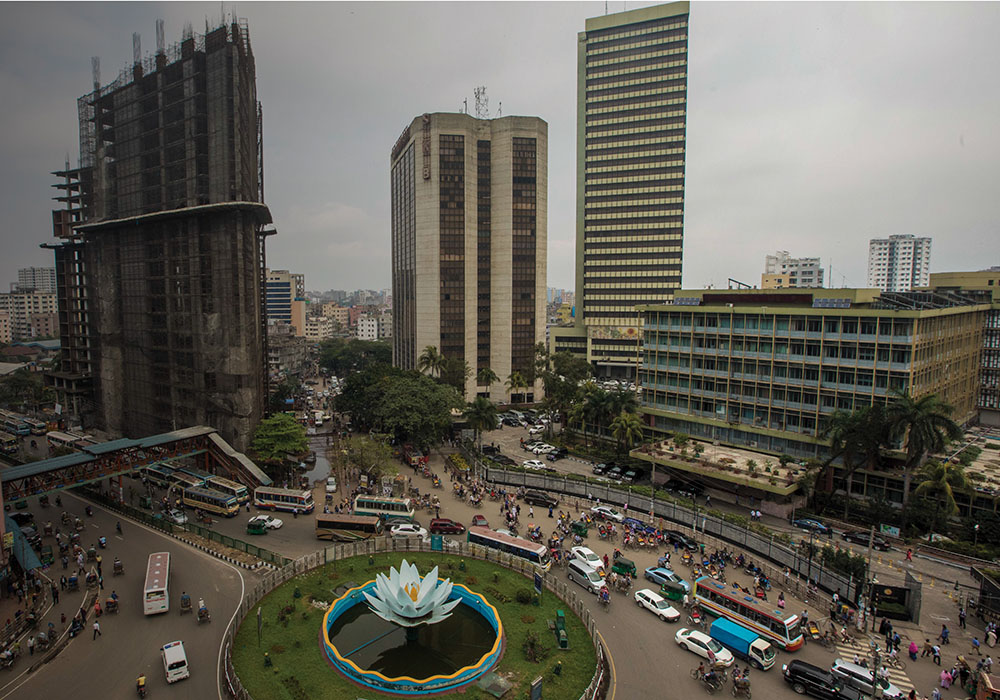
All the given factors created a situation where cars and motorcycles are becoming increasingly a necessity for the middle class, to get around in Dhaka. As a result, further congesting the roads and worsening air pollution, noise, and safety problems. The number of the registered motorized vehicle stands at 1,255,402 in April 2018 increasing from 303,215 in 2003 (a fourfold increase in 15 years). More than 36% of all registered vehicles are in Dhaka (total 3,419,884 in Bangladesh) (BRTA, 2012; BRTA, 2018).
The alarming trend which can be spotted is that, while the percentage of buses and minibusses remain almost the same in this period; private vehicles, particularly the number of cars and motorcycles almost tripled. Public transport such as buses and minibusses has grown at a very insignificant rate even though the demand for public transport services is increasing. Motorcycles and cars constitute around 54% and 26% of total motorized vehicles respectively.
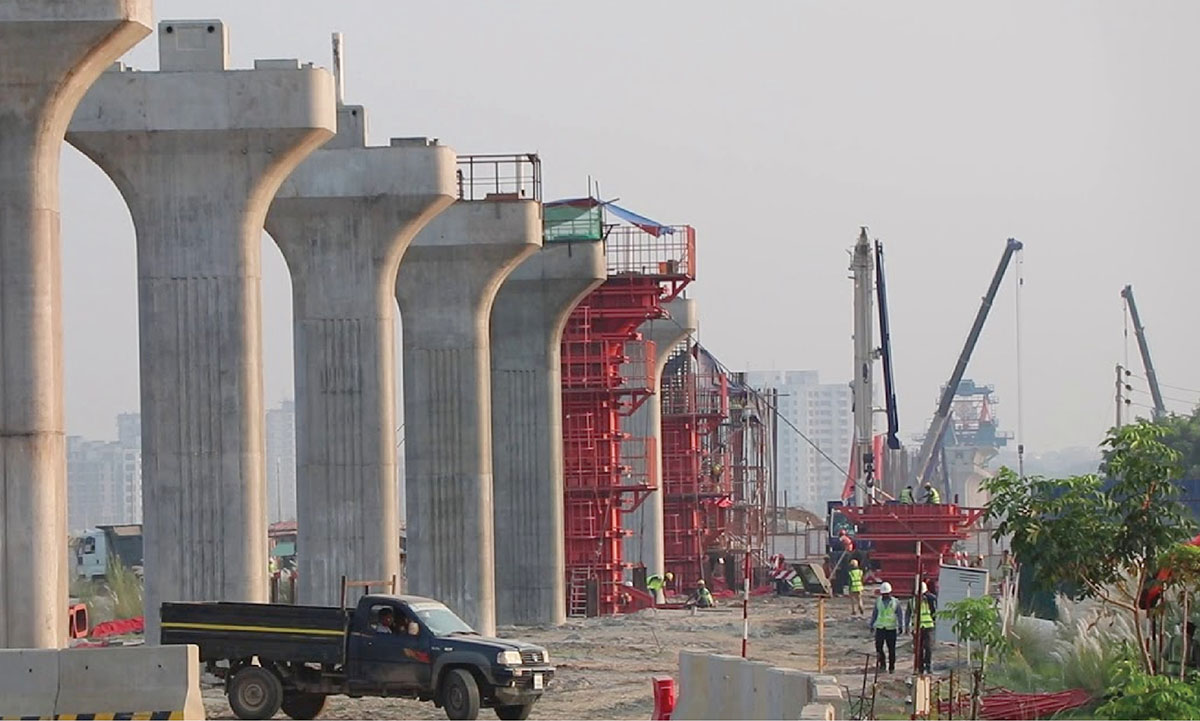
To improve the current situation and reorganize the existing traffic system methodically, the government prepared the Strategic Transport Plan (STP) for Dhaka (2005); which has been recently revised (it has now become Revised Strategic Transport Plan, RSTP from 2015). It recommended a package of comprehensive programs for the development of transport infrastructure over a 20 year period. This strategy includes various types of development agendas, such as three Bus Rapid Transit (BRT) and Mass Rapid Transit (MRT) (Metrorail) routes, more than 50 highway projects, expressways, flyovers etc.
Conclusion
If Dhaka needs to survive the juggernaut called ‘development’ and ‘urbanization’, it must make a proper plan not only to provide guidelines on paper but also for implementation in the realm; where there is no room for a mistake. Already authorities tried to and have been successful in banning NMTs from some parts of the city. So, like other developing cities around the world, NMTs will be restricted in the near future for Dhaka too. Hence, for transportation equity and accessibility, not only public transit is necessary but also Mass Rapid Transit (MRT) (e.g. subway, BRT, LRT etc.) are required and these projects must not fail to achieve their intended goals. We sincerely hope that the ongoing projects of MRT and BRT will help to ease the present horrendous situation.